

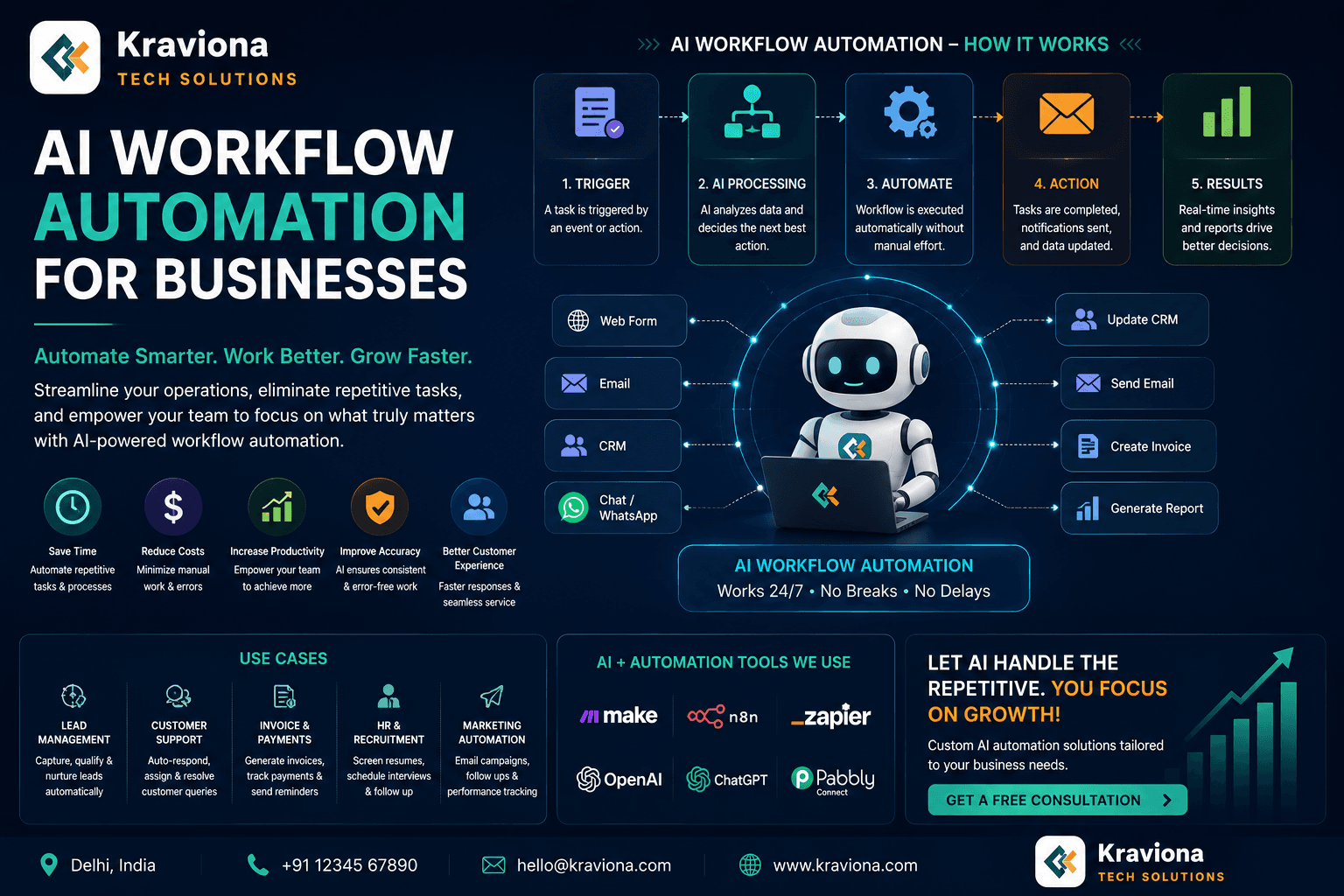
AI workflow automation for businesses is no longer optional — it is how serious companies in Delhi, Bangalore, and Mumbai are cutting operational costs by 40% and closing deals faster. This guide brea…
Every business owner in India has the same complaint. Too much time spent on tasks that should not require a human. Chasing payment confirmations. Copying data from one spreadsheet to another. Sending the same follow-up message to 50 leads. Updating the team on order statuses that a computer already knows. This is not a staffing problem. It is a systems problem. And AI workflow automation for businesses is exactly how you fix it.
This is not about replacing your team. It is about giving them back their time. The businesses growing fastest right now in Delhi, Bangalore, Mumbai, and Hyderabad are not the ones with the biggest headcount. They are the ones with the sharpest systems. Systems where the repetitive work runs on autopilot and the humans focus on what actually moves the needle.
This guide covers what AI workflow automation actually means in practice, which workflows give you the fastest returns, how to set one up without a massive IT budget, and what mistakes most Indian businesses make that kill the results before they start.
What AI Workflow Automation for Businesses Actually Means
There is a lot of noise around this term. Let us be precise about what it is and what it is not.
The Core Idea
A workflow is any sequence of tasks that moves a process from start to finish. A customer fills out a form, someone enters the data into a CRM, someone else sends a welcome email, a third person creates an invoice, and a fourth person logs the payment. That is a workflow. Every step in that chain has a trigger, a condition, and an action.
AI workflow automation means software handles those steps automatically, applies intelligence to make decisions within the workflow, and escalates to a human only when something genuinely requires judgment. The "AI" part matters because it goes beyond simple rule-based automation. It can read an email and understand the intent. It can prioritize a lead based on behavior. It can catch anomalies in a payment report that a static rule would miss.
If you want to understand the foundation before diving deeper, this breakdown of what AI automation in business actually means in practice is a good starting point.
Workflow Automation vs. Business Process Automation vs. RPA
These terms get used interchangeably, which causes confusion when you are trying to evaluate vendors or build a strategy.
Workflow automation is the broadest category. It covers any automated sequence of tasks. Business Process Automation (BPA) is more focused on end-to-end business processes like onboarding, procurement, or invoice approval. Robotic Process Automation (RPA) specifically refers to software robots that mimic human actions on a computer screen, like clicking buttons or copying data from a legacy system that has no API.
AI workflow automation sits above all three because it adds a layer of intelligence. It does not just follow a script. It reads context, adapts to new inputs, learns from historical data, and makes decisions within defined boundaries. For most growing Indian businesses, this distinction matters when you are choosing between a cheap tool and a system that actually scales with your operations.
Why 2026 is the Year to Act
The cost of AI tooling has dropped dramatically. Three years ago, a custom AI automation system cost tens of lakhs. Today, with the right tech stack and a focused implementation partner, a mid-size business in Pune or Gurugram can get production-ready workflows live for a fraction of that cost. The barrier to entry is lower than it has ever been. The businesses that move now build compounding advantages over competitors who are still doing things manually.
The Workflows That Give Indian Businesses the Fastest Returns
Not all automation is equal. Some workflows save 20 minutes a week. Others save 20 hours. The ones worth attacking first are high-frequency, high-volume, and currently eating your most expensive resource: human attention.
Lead Capture and Qualification
A lead comes in from your website, IndiaMART listing, or Google Ad. Someone on your team sees it three hours later, enters it into the CRM, and sends a follow-up message. By then, two other vendors have already called. This is a real problem for businesses in competitive markets like real estate, education, manufacturing, and SaaS.
An AI workflow catches the lead the moment it arrives. It enriches the data by pulling company size, location, and prior interactions. It scores the lead based on your ideal customer profile. It sends a personalized WhatsApp message within 60 seconds. It books a meeting if the lead responds. The sales team wakes up to a calendar full of conversations, not a pile of unread form submissions.
Invoice Processing and Finance Reconciliation
Finance teams at Indian businesses spend an extraordinary amount of time on reconciliation. Purchase orders, GST invoices, Tally entries, Razorpay settlements, and bank statements that need to match up. An AI-powered workflow can read invoices from email using OCR, extract the relevant fields, validate them against purchase orders in your ERP, flag discrepancies, and push clean entries into Tally or Zoho Books automatically.
What used to take a CA or accounts executive two days a month can run overnight. The human reviews exceptions. The routine matches go through without anyone touching them.
Customer Support Triage and Escalation
WhatsApp Business, email, and web chat are all feeding support queries into your team simultaneously. Most of those queries are the same 10 questions. AI can handle them without a support agent. It reads the query, identifies the category, pulls the right answer from your knowledge base, and responds. When a query falls outside the defined scope or carries a frustrated tone, it escalates to a human with full context already attached.
This is especially powerful for e-commerce businesses in India where order status queries, return requests, and delivery complaints represent 70 to 80 percent of incoming support volume.
Reporting and Performance Dashboards
Leadership teams spend hours every week compiling reports that should compile themselves. Sales numbers from Zoho CRM. Marketing spend from Google Ads. Revenue from Razorpay. Operational data from your custom ERP. An AI workflow pulls all of this on a schedule, runs the calculations, and delivers a ready dashboard to your email or Slack every Monday morning. No one needs to touch a spreadsheet.
AI Workflow Automation Tools: What Actually Works in India
The tools you choose depend on your existing stack, technical capacity, and the complexity of what you are building. Here is an honest breakdown.
No-Code and Low-Code Platforms
Zapier and Make (formerly Integromat) are the entry point for most small businesses. They offer thousands of pre-built integrations and a visual workflow builder. You can connect your website form to Google Sheets to WhatsApp Business to Zoho CRM without writing a single line of code. The limitation is that they struggle with complex conditional logic and are not built for high-volume Indian payment gateway integrations at scale.
n8n is an open-source alternative that gives you much more control. It can be self-hosted, which matters for businesses with data privacy requirements. It handles more complex logic and is increasingly popular with Indian tech teams who want flexibility without a large recurring SaaS bill.
AI-Native Tools
Platforms like Relevance AI, Bardeen, and Clay bring actual intelligence into the workflow. They can read emails, classify documents, enrich leads, and generate content as part of an automated sequence. These are powerful but require more setup and a clearer understanding of what you are automating and why.
If you want to understand how tools like ChatGPT fit into the business automation picture, this guide on how to use ChatGPT for business covers practical applications across marketing, operations, and customer service.
Custom-Built Systems
For businesses with unique processes, existing legacy systems (like older versions of Tally or custom ERPs), or specific compliance requirements, off-the-shelf tools hit a ceiling fast. A custom-built automation layer using Node.js, Python, and a message queue like BullMQ or RabbitMQ gives you complete control over logic, data, error handling, and integrations. This is where working with an in-house development team becomes critical, because debugging a complex automation that breaks in production is not something you want to hand to a freelancer you cannot hold accountable.
AI Workflow Automation by Industry: What Indian Businesses Are Automating
| Industry Top Workflows Automated Tools Commonly Used Time Saved Per Week | |||
| E-commerce | Order updates, return processing, abandoned cart recovery | Razorpay, Shiprocket, WhatsApp API | 25-40 hours |
| Real Estate | Lead scoring, site visit scheduling, follow-up sequences | Zoho CRM, WhatsApp Business, 99acres API | 20-30 hours |
| Finance / CA Firms | Invoice matching, GST filing prep, client reporting | Tally, Zoho Books, custom OCR | 15-25 hours |
| Healthcare | Appointment reminders, prescription follow-ups, billing | WhatsApp API, custom EHR integration | 20-35 hours |
| EdTech | Lead nurturing, fee reminders, certificate generation | Razorpay, Zoho CRM, email automation | 18-28 hours |
| Logistics | Shipment tracking updates, vendor communication, POD matching | Custom ERP, WhatsApp, email | 30-50 hours |
| SaaS / Tech | User onboarding, churn detection, support ticket routing | Intercom, Mixpanel, custom AI models | 15-20 hours |
How to Set Up AI Workflow Automation: A Step-by-Step Process
Most businesses make the mistake of starting with the technology. They buy a tool, try to connect everything, and give up when nothing works cleanly. The right approach starts with the problem, not the platform.
Step 1: Audit Your Current Workflows
Spend one week documenting what your team actually does. Not what the org chart says they do. What they actually spend their time on. You will find clusters of repetitive, manual tasks hiding inside every department. Sales enters the same data in three places. Finance chases the same approvals every month. Operations sends the same status update to the same people on the same schedule. Write these down. Assign a rough time cost to each. This gives you your automation priority list.
Step 2: Identify the High-ROI Workflows First
Sort your list by two variables: frequency and time cost per instance. A task that happens 200 times a month and takes 5 minutes each is 1,000 minutes saved per month if you automate it. A task that happens twice a year and takes 2 hours is not your first priority. Start with the workflows that compound. Lead follow-ups, invoice processing, and customer support triage usually top the list for Indian businesses.
Step 3: Map the Trigger, Conditions, and Actions
For every workflow you plan to automate, define three things precisely. What triggers the workflow to start? What conditions or logic does it need to apply? What actions does it execute and in what sequence? This is not a technical document. It is a plain-language description of the process. If you cannot describe it clearly in plain language, you are not ready to automate it. The ambiguity in your description will become a bug in your automation.
Step 4: Choose the Right Tool for the Workflow
Not every workflow needs a custom-built system. A simple lead-to-CRM-to-WhatsApp flow can run on Zapier in two days. A complex invoice processing system that reads PDFs, validates against ERP data, and pushes clean entries to Tally needs custom development. Match the tool to the complexity. Overbuilding wastes money. Underbuilding creates brittle systems that break at the worst moment.
Step 5: Build With Error Handling From Day One
The most common failure point in automation projects is poor error handling. What happens when an API times out? When a lead form sends incomplete data? When a payment gateway returns an unexpected response? Every workflow needs a clear answer to these questions. Log the error, alert a human if necessary, and define what "retry" means for your specific process. Systems without error handling work fine in testing and break spectacularly in production.
Step 6: Test With Real Data Before Going Live
Never test automation with dummy data only. Real customer names, real email addresses, real invoice amounts. Dummy data hides edge cases that real data exposes immediately. Run your workflow with real inputs in a staging environment. Break it intentionally. Try empty fields, special characters in names, amounts with decimal issues, email addresses with unusual formats. Then fix what breaks before real customers experience it.
Step 7: Monitor, Measure, and Iterate
An automation is not done when it goes live. It is done when you have measured whether it is achieving its goal. Track the time saved, error rate, and business outcome linked to each workflow. Revisit it every quarter. Processes change. New tools get added to your stack. A workflow built for 100 transactions per day needs to be rethought when you are doing 2,000.
Real Results: What Indian Businesses Are Seeing
These are not hypothetical projections. They are outcomes from businesses that have implemented AI workflow automation with focused execution.
A Delhi-Based Real Estate Agency
This agency was handling 300 to 400 inbound leads per month from 99acres, Housing.com, and their website. Their sales team of 6 people was manually calling every lead, logging notes in a shared spreadsheet, and sending WhatsApp messages one by one. Response time averaged 4 to 6 hours. Close rate was around 3 percent.
After implementing an AI lead automation workflow, the first response went out via WhatsApp within 90 seconds of the lead arriving. The system scored the lead based on budget, location preference, and query intent. High-intent leads were escalated to senior sales staff immediately. Low-intent leads entered a nurture sequence. Within 90 days, response time was under 2 minutes, the sales team was spending 60 percent less time on data entry, and the close rate moved from 3 percent to 6.5 percent.
A Pune-Based E-Commerce Brand
A direct-to-consumer brand selling skincare products online was drowning in customer support queries. 70 percent of their support tickets were order status questions. Their team of 3 support agents was spending 5 hours a day answering the same questions. Customer satisfaction scores were dropping because response times exceeded 12 hours during peak periods.
An AI-powered WhatsApp support workflow was set up to handle order status queries automatically using their Shiprocket and Razorpay data. Within two weeks of going live, 65 percent of incoming queries were resolved without a human. Support agents redirected their time to returns, complaints, and product questions where their judgment added real value. Average response time dropped to under 3 minutes.
This is the pattern you see repeatedly across industries. Automation removes the volume problem. People solve the complexity problem. The combination is what drives real business growth, which is precisely what separates businesses using the right AI tools for small business from those still running on WhatsApp groups and spreadsheets.
Common Myths About AI Workflow Automation That Are Costing You
There is no shortage of wrong beliefs about automation in the Indian business community. Some come from vendors who oversell. Some come from consultants who overcomplicate. Here are the ones that most often delay action or lead to failed projects.
Myth 1: You Need a Big IT Team to Automate
This was true five years ago. It is not true now. Modern automation platforms are designed for business users, not engineers. A founder with basic tech literacy can set up functional Zapier workflows in an afternoon. For more complex systems, a focused external team can deliver working automation in 2 to 4 weeks without requiring you to hire an internal IT department. The technical complexity has moved from your side to the platform side.
Myth 2: Automation Only Works for Large Businesses
Small businesses arguably benefit more from automation than large ones because they have less human capacity to absorb repetitive work. A 10-person team in Noida that automates lead follow-ups and invoice processing effectively operates with the leverage of a 15-person team. The productivity gain per rupee invested is higher at smaller scale because the baseline manual overhead is proportionally larger.
Myth 3: Once Built, You Can Forget It
Automation requires maintenance. APIs change. Business processes evolve. New tools get added to your stack. A workflow that was built 18 months ago and never touched may be running on deprecated integrations or missing edge cases that did not exist when it was first built. Treat automation like any other operational asset. Review it regularly, update it when your business changes, and build in monitoring so you know when something breaks.
Myth 4: AI Will Make Decisions Your Business Cannot Afford to Get Wrong
This is the most common fear, and it is based on a misunderstanding of how well-built AI automation works. You define the boundaries. The AI operates within them. For decisions with serious consequences, you set a confidence threshold below which the workflow escalates to a human rather than acting autonomously. Credit decisions, legal communications, sensitive customer situations — these get flagged for human review. Routine, high-volume, low-stakes decisions run automatically. The division is your choice, not the machine's.
The rise of autonomous AI agents is a real trend, but responsible implementation always keeps a human in the loop for decisions that matter. The businesses getting the most out of automation are the ones that draw this line thoughtfully, not fearfully.
Myth 5: Cheap Tools Give You the Same Result as Custom Systems
For simple workflows, yes. For anything that involves your core business process, no. A no-code tool that breaks when your transaction volume doubles is not saving you money. A generic chatbot that cannot handle Hindi queries or understand GST invoice formats is not solving your Indian business problem. The cost of a poorly built automation that fails at scale is higher than the cost of doing it right the first time.
AI Workflow Automation and SEO: A Bonus You Did Not Expect
Most conversations about automation focus on operations. But AI workflow automation has a direct impact on your digital visibility too, which matters if you depend on search traffic for lead generation.
Automated Content Operations
Publishing consistent content is one of the highest-return SEO activities a business can do. It is also one of the most neglected because it requires consistent human effort. Automation can handle the distribution, internal linking, schema updates, and performance tracking. The content itself still needs human expertise, but everything around the content can run on a workflow.
Technical SEO Monitoring
Broken links, missing meta tags, slow page load times, and crawl errors compound over time if no one is watching them. An automated monitoring workflow can check your site daily, log issues, and send you a prioritized alert when something needs fixing. This is far more effective than a quarterly manual audit. Understanding the fundamentals of technical SEO is important before you automate the monitoring because you need to know what you are watching for and why it matters.
Lead Attribution and Reporting
Where are your leads actually coming from? Organic search, Google Ads, WhatsApp referrals, or direct traffic? An automated attribution workflow ties UTM parameters to CRM entries, connects Razorpay payment data to traffic sources, and builds you a clean picture of which channels are actually driving revenue. Most Indian businesses are flying blind on this because connecting the data manually is too labor-intensive. Automation makes it continuous and invisible.
Frequently Asked Questions
What is AI workflow automation for businesses?
AI workflow automation for businesses means using artificial intelligence to handle repetitive, rule-based, or judgment-intensive tasks automatically. Instead of a human manually moving data from one system to another, sending follow-up emails, updating spreadsheets, or generating reports, an AI-powered workflow does it without being asked. It connects your tools, applies logic, learns from patterns, and executes tasks faster and more accurately than any manual process.
Which Indian businesses benefit the most from AI workflow automation?
Any Indian business that runs on repetitive processes benefits. E-commerce companies automate order confirmations, returns, and customer follow-ups. Real estate agencies automate lead qualification and WhatsApp follow-ups. CA firms and finance teams automate Tally reconciliation and invoice processing. Logistics companies automate shipment tracking and vendor communication. Even small businesses with 5 to 10 employees see massive gains once they automate their lead management and customer communication.
How much does AI workflow automation cost for a small business in India?
The cost depends on the complexity and number of workflows. Basic automation using tools like Zapier or Make can start at Rs 2,000 to Rs 5,000 per month for simple trigger-action flows. Custom AI-powered workflows built specifically for your business, integrating with Zoho CRM, Razorpay, and WhatsApp Business, typically cost Rs 50,000 to Rs 2,00,000 for the initial build, with ongoing support starting around Rs 10,000 per month.
Will AI workflow automation replace my employees?
No. AI workflow automation does not replace people. It removes the repetitive, low-value work that wastes your team's time. A sales executive who used to spend 3 hours updating the CRM and sending follow-up emails can now spend those 3 hours having actual conversations and closing deals. Automation handles the routine. Your people handle the complex, relationship-driven, and creative work that actually requires a human mind.
How long does it take to implement AI workflow automation for a business in India?
Simple automations can go live within a week. A lead capture to CRM to WhatsApp message flow can be set up in 2 to 3 days. More complex systems that integrate your website, payment gateway, ERP, and customer support platform typically take 3 to 8 weeks. Kraviona Tech follows 2-week sprint cycles so you see working automation fast rather than waiting months for a big reveal.
Ready to Automate What Is Slowing You Down
AI workflow automation for businesses is not a future investment. It is a present-day competitive advantage that your competitors in Delhi, Bangalore, and Hyderabad are either already using or actively exploring. Every week you delay is another week of manual work that could have been running on autopilot.
The businesses we work with at Kraviona Tech come to us with one of three problems. Too much time lost to repetitive tasks, too many errors in manual processes, or a team that cannot scale because the systems cannot keep up with the growth. In every case, the answer starts with a clear automation strategy, not a rushed tool purchase.
If you want to understand what your specific automation opportunity looks like before spending a rupee, start a conversation. We will audit your current workflows, identify the three highest-ROI automations for your business, and give you a practical roadmap. No jargon. No overselling. Just an honest assessment of what makes sense for where your business is right now.
Reach us at kravionatech@gmail.com and let us talk through what AI workflow automation can do specifically for your business. If you are evaluating what kind of agency you want to work with, this overview of how Kraviona operates as an AI automation agency in India covers our approach, team structure, and the kind of outcomes we hold ourselves accountable to.
]]>
Amar Kumar
July 18, 2026
Reader Response
What did you think?
Comments help us improve future articles.
4
0