

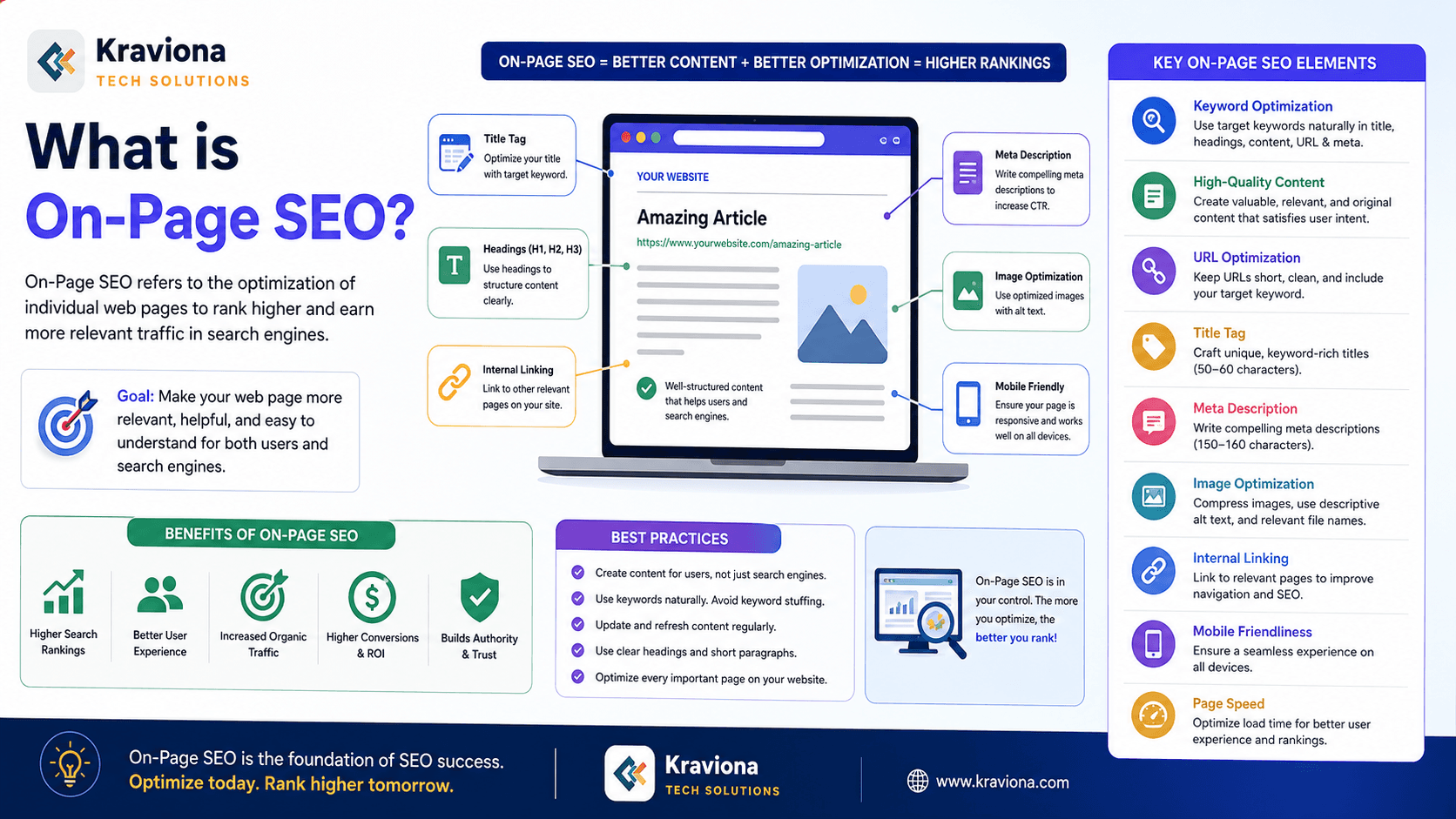
On-page SEO refers to all the optimizations made directly to a web page — content, headings, meta tags, structured data, and internal links to improve its relevance and ranking potential. Here is the …
Quick Answer
On-page SEO is the practice of optimizing a web page's content, HTML elements, and structure to improve its relevance and ranking potential in search engine results. This includes title tags, meta descriptions, heading hierarchy, content quality, keyword placement, internal links, image optimization, structured data, and E-E-A-T signals — all elements that you directly control on your own pages.
Key Takeaways
- On-page SEO covers all optimizations made to a page itself — distinct from technical SEO (infrastructure) and off-page SEO (backlinks)
- Search intent alignment is the most important and most commonly missed on-page factor in 2026
- Title tags should be under 60 characters, unique per page, and include the primary keyword naturally near the front
- Structured data (JSON-LD schema) is increasingly important for both rich results and AI Overview citations
- E-E-A-T signals — author credentials, testimonials, cited sources — are now essential for competitive content spaces
- Internal linking is one of the most underused on-page tools for distributing authority and reinforcing topical relevance
Introduction
Ask ten different SEO consultants to define on-page SEO and you will get ten slightly different answers — some focused narrowly on title tags and keywords, others expanding into content depth, user experience, and structured data. The truth is that on-page SEO has evolved significantly over the past few years, and what constituted best practice in 2020 is only part of the picture in 2026. This guide gives you the complete, current definition — and more importantly, a practical framework for actually implementing it.
What is On-Page SEO?
On-page SEO refers to all the optimizations made directly to a web page — its content, HTML structure, and metadata — to improve its relevance, quality, and ranking potential in search engine results. It is called on-page because these are factors you control on your own site, as opposed to off-page SEO (backlinks, brand mentions, external signals) or technical SEO (crawlability, rendering, site architecture).
In 2026, on-page SEO is not just about placing keywords in the right HTML elements. It is about creating a page that comprehensively addresses the search intent behind a query, demonstrates genuine expertise and authority, and provides a clear, well-structured experience for both human users and search engine crawlers. Search engines have become sophisticated enough to evaluate topical depth, content quality, and user engagement — not just keyword placement.
On-Page SEO vs Technical SEO vs Off-Page SEO
Understanding where on-page SEO ends and the other two pillars begin helps you allocate effort correctly:
- On-page SEO: Everything on the page itself — content, keywords, headings, meta tags, images, internal links, structured data, and user experience signals within that page.
- Technical SEO: The infrastructure level — how pages are crawled, rendered, indexed, and served. Site speed, Core Web Vitals, mobile responsiveness, XML sitemaps, robots.txt, and server-side rendering all live here. Our technical SEO guide covers this dimension in detail.
- Off-page SEO: Authority signals from outside your site — backlinks, brand citations, reviews, and social proof. These tell search engines how much the broader web trusts your domain.
All three work together. Strong on-page SEO on a technically broken site will underperform. And even perfectly optimized pages will struggle to rank for competitive keywords without domain authority. But on-page SEO is the one pillar you have the most direct control over — and where most sites have the most room to improve immediately.
The Core Elements of On-Page SEO in 2026
1. Title Tags
The title tag is the clickable headline that appears in search results. It is one of the most important on-page signals for telling Google what a page is about. Best practice in 2026: keep it under 60 characters, include your primary keyword naturally near the beginning, make it compelling enough that users choose to click it over competing results, and ensure every page on your site has a unique title. A weak or duplicate title tag is one of the most common and costly on-page mistakes — and it is also one of the easiest to fix.
2. Meta Description
The meta description does not directly influence rankings, but it influences click-through rate — which does influence rankings indirectly through user engagement signals. A strong meta description summarizes the page's value in under 150 characters, includes a natural instance of the target keyword, and ends with an implicit or explicit call to action. Google sometimes rewrites meta descriptions based on the query, but providing a well-written one increases the probability of your intended message appearing in results.
3. Heading Structure (H1–H6)
Headings serve two purposes — they organize content for readers and they signal topical structure to crawlers. Every page should have exactly one H1 that clearly states the primary topic of the page (usually matching or closely reflecting the target keyword). H2s break the content into major sections. H3s provide subsections. This logical hierarchy helps both users navigate and Googlebot understand the semantic relationships between content sections. A page with no H1, multiple H1s, or random heading usage is leaving significant on-page signal on the table.
4. Content Quality and Search Intent Alignment
This is the most important and most nuanced element of on-page SEO in 2026. Content must actually satisfy the search intent behind the target keyword — not just contain the keyword phrase. Search intent refers to what the user is trying to accomplish: are they looking for a definition, a how-to guide, a product comparison, or a specific tool? A page targeting 'what is on-page SEO' needs to be informational and comprehensive. A page targeting 'on-page SEO service' needs to be transactional and persuasive. Misaligning content type with search intent is one of the most common reasons pages fail to rank despite having technically correct optimization.
For businesses investing in content as a channel, this is where the real work is. Kraviona's content production for kraviona.com follows a process of SERP analysis before writing — studying what format, depth, and angle the current top-ranking pages use before deciding on content structure. This is what makes the difference between content that ranks and content that sits idle.
5. Keyword Placement and Semantic Coverage
In 2026, keyword placement is less about exact-match density and more about topical completeness. Google's natural language understanding means a page covering a topic comprehensively will outperform a page that keyword-stuffs its primary phrase. That said, strategic placement still matters: your primary keyword should appear in the title tag, H1, first paragraph, and naturally throughout the body. Beyond the primary keyword, your content should cover semantically related terms — the supporting concepts, questions, and vocabulary that a thorough treatment of the topic would naturally include. This is what SEOs call semantic coverage, and it is increasingly a differentiator between pages that rank in positions 1–3 versus positions 10+.
6. Internal Linking
Internal links do two important things: they distribute page authority across your site and they help users discover related content. Each page should link contextually to the most relevant related pages using descriptive anchor text that signals what the linked page is about. Kraviona's blog, for example, links from content marketing posts to service pages, from technical guides to related blog posts, and from every article to the contact page — creating a network of relevance signals that reinforces topical authority. A site where pages exist in isolation with no internal links is leaving significant ranking potential unused. Read more in our website audit guide about how internal link audits surface these missed connections.
7. Image Optimization
Every image on a page should have a descriptive, keyword-relevant alt attribute — both for accessibility and to give crawlers context about the image's content. File names should be descriptive (not IMG_4823.jpg). Images should be appropriately sized and served in modern formats like WebP to prevent Core Web Vitals failures. Next.js's built-in Image component handles many of these automatically — one of the practical advantages of the framework for SEO.
8. Structured Data (JSON-LD Schema)
Structured data tells search engines exactly what type of content is on a page and provides explicit metadata in a machine-readable format. For blog articles, this means Article or BlogPosting schema. For FAQ sections, FAQPage schema enables rich results directly in SERPs. For service pages, Service and LocalBusiness schema increases visibility in local and featured results. For e-commerce, Product schema enables star ratings and price in search results. In 2026, structured data is also increasingly important for appearing in AI Overviews and LLM-generated responses — which increasingly cite well-structured, schema-marked content.
9. E-E-A-T Signals
Google's E-E-A-T framework — Experience, Expertise, Authoritativeness, and Trustworthiness — has become a central on-page consideration for any site competing in YMYL (Your Money or Your Life) topics or in competitive commercial spaces. Practical E-E-A-T improvements include adding author biographies with credentials and links to professional profiles, displaying client testimonials and case studies, citing sources and statistics, ensuring your About page accurately represents your organization's background and credentials, and maintaining factual accuracy across all content.
📖 Related Reading: To understand how on-page SEO connects to the broader technical health of your site, read our guides on what technical SEO is and what a website audit covers. For businesses using AI tools in their SEO workflow, our guide on AI automation in business explores how content production can be accelerated without sacrificing quality.
Common On-Page SEO Mistakes in 2026
- Duplicate title tags and meta descriptions across multiple pages, which confuses crawlers about which page to rank for a given query
- Missing H1 or multiple H1s on the same page, weakening the topical signal
- Thin content that does not adequately address search intent, even if it contains the right keywords
- No internal links leaving pages in isolation and failing to pass authority through the site
- Missing structured data on article, FAQ, and service pages — a missed opportunity for rich results and AI citation
- Images without alt text, both an accessibility failure and a missed keyword signal
Conclusion
On-page SEO in 2026 is not a checklist exercise — it is a discipline of aligning your content, structure, and signals with both what search engines can understand and what users genuinely need. The businesses that treat it as a one-time optimization task will plateau. The businesses that build on-page SEO thinking into their content production process — starting every piece of content with intent analysis, structuring it for both users and crawlers, adding structured data, and linking it into the broader site architecture — will compound their organic visibility quarter over quarter.
If you want Kraviona to audit and optimize the on-page SEO of your website or build a content strategy around high-value keywords, contact us today. View our pricing or book a free 30-minute strategy call to get started.
Frequently Asked Questions
What is on-page SEO?+
On-page SEO is the practice of optimizing the content, HTML elements, and structure of individual web pages to improve their relevance and ranking potential in search engines. This includes optimizing title tags, meta descriptions, heading structure, content quality and depth, keyword placement, internal links, images, structured data, and E-E-A-T signals — all factors that you directly control on your own website.
What is the difference between on-page SEO and off-page SEO?+
On-page SEO refers to optimizations made directly on your website — content, meta tags, structured data, internal links, and page structure. Off-page SEO refers to external signals that affect your rankings — primarily backlinks from other websites, brand mentions, and reviews. On-page SEO is fully within your control; off-page SEO requires building authority and relationships with external sites and audiences.
What are the most important on-page SEO factors in 2026?+
The most impactful on-page SEO factors in 2026 are search intent alignment (does the content actually answer what the user is looking for?), content depth and topical completeness, title tag optimization, structured data implementation (JSON-LD schema), E-E-A-T signals (author credentials, citations, testimonials), and internal linking. Keyword placement remains important but has become less about exact-match frequency and more about semantic relevance.
What is search intent and why does it matter for on-page SEO?+
Search intent is the underlying goal of a user's search query — whether they want information, a specific page, a product, or to take an action. It matters because Google ranks content that best satisfies the intent behind a query, not just content that contains the keyword. A page targeting an informational keyword must be comprehensive and educational. A page targeting a transactional keyword must make it easy to take action. Misaligning content type with search intent is one of the most common reasons pages fail to rank.
How do title tags affect SEO?+
Title tags are one of the strongest on-page signals for communicating a page's topic to search engines. They appear as the clickable headline in search results and influence both rankings and click-through rate. Best practice is to keep title tags under 60 characters, include the primary keyword naturally near the beginning, make each title unique across the site, and write it to be compelling for human readers, not just search engines.
What is structured data and how does it help on-page SEO?+
Structured data is machine-readable code (usually JSON-LD format) added to a page that explicitly tells search engines what type of content the page contains and provides metadata in a standardized format. It enables rich results in search — star ratings, FAQ dropdowns, recipe cards, and more — which increase click-through rates. In 2026, structured data is also important for appearing in AI Overviews and being cited by large language models that synthesize information from web content.
What is E-E-A-T and how does it relate to on-page SEO?+
E-E-A-T stands for Experience, Expertise, Authoritativeness, and Trustworthiness — Google's framework for evaluating the quality and credibility of web content. On-page, E-E-A-T is demonstrated through author bylines with credentials and professional links, cited sources and data, accurate and up-to-date information, client testimonials and case studies, a clear About page, and contact information. Sites competing in commercial or sensitive topic areas need strong E-E-A-T signals to rank consistently.
Amar Kumar
July 18, 2026
Reader Response
What did you think?
Comments help us improve future articles.
0
0