

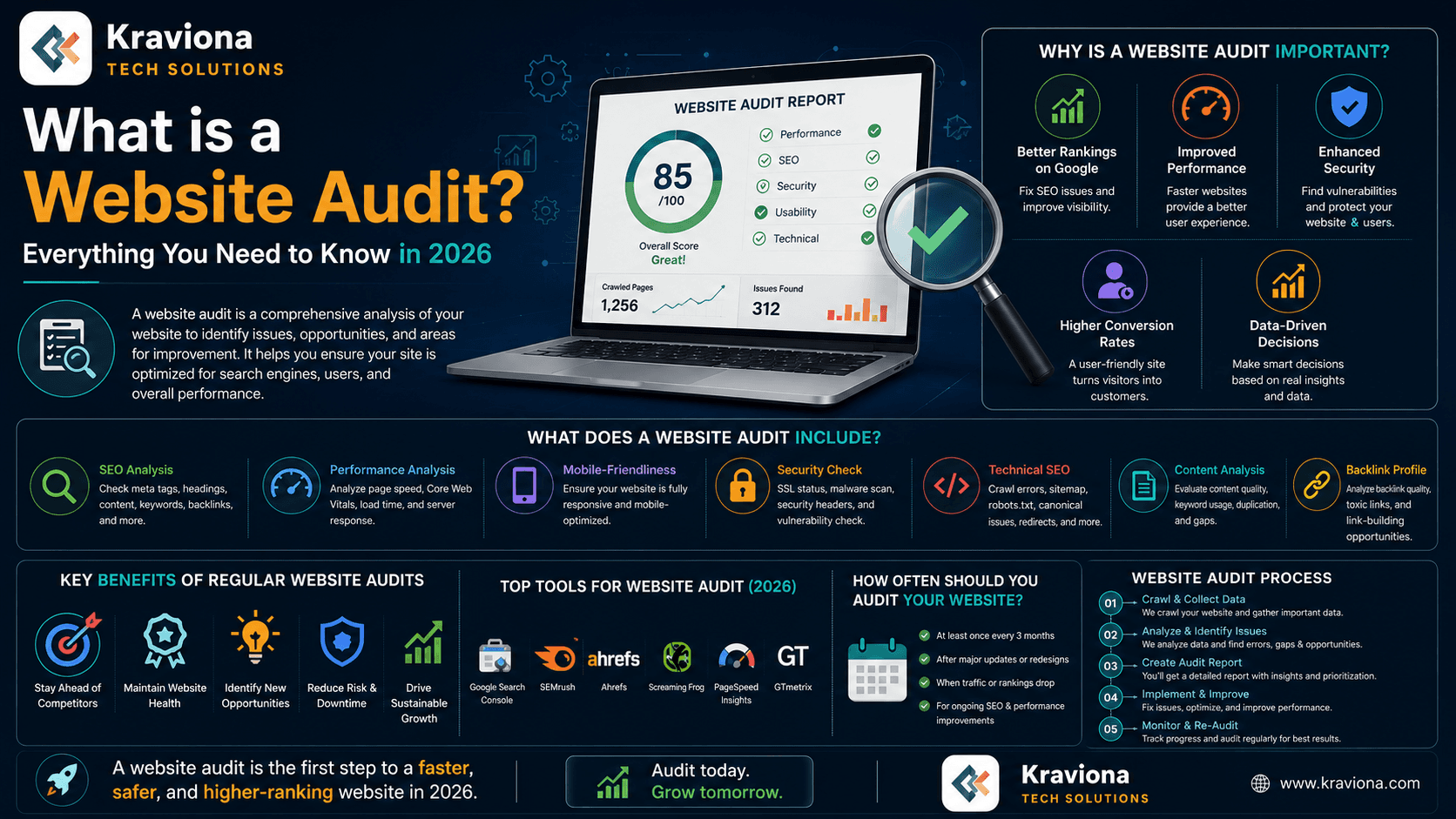
A website audit is a comprehensive review of a site's technical health, SEO performance, content quality, and user experience. Learn what it covers, why you need one, and how often to do it in 2026.
Quick Answer
A website audit is a structured, multi-dimensional analysis of a website across technical SEO, on-page optimization, content quality, performance, and backlink authority. The goal is to identify issues limiting the site's ability to rank in search engines, convert visitors, and function correctly — and to produce a prioritized roadmap for fixing them.
Key Takeaways
- A website audit covers technical SEO, on-page signals, content quality, performance, and backlink health
- For JavaScript-heavy sites (React, Next.js, MERN), rendering audits are especially critical — content invisible to crawlers will not rank
- Most businesses are unaware of the technical issues their sites have because the issues are invisible to normal browsing
- Missing structured data (JSON-LD) means missed opportunities for rich results and AI Overview citations
- A full audit should be done at least once per year, with lighter quarterly technical checks for active SEO campaigns
- The output of an audit is not just a list of problems — it is a prioritized, actionable roadmap
Introduction
Your website is either working for your business or working against it — and in most cases, you will not know which until someone looks under the hood. That is what a website audit does. It is not about aesthetics or personal preference. It is a structured, technical, and strategic review of everything affecting how your site performs for users and how it ranks for search engines. If you have never had one done, this guide explains exactly what it covers, why it matters, and what you should expect from the process.
What is a Website Audit?
A website audit is a comprehensive analysis of a website across technical, SEO, content, performance, and user experience dimensions. The goal is to identify issues that are limiting the site's ability to rank in search engines, convert visitors, or function correctly across devices and browsers.
A proper website audit is not a single report — it is a diagnostic process that uncovers the gap between where your site is today and where it needs to be to meet your business goals. Think of it as a health check for your digital presence — not just a snapshot, but an actionable roadmap.
Kraviona recently conducted a full technical audit of kraviona.com and surfaced issues that are common across most Next.js and MERN-based sites: SSR rendering gaps that make content invisible to crawlers, missing JSON-LD structured data, inconsistent on-page signals, and absent social proof elements. These issues rarely surface through normal day-to-day site management — they require a deliberate audit to find.
What Does a Website Audit Cover?
1. Technical SEO Audit
This is often the most critical component for businesses building on modern JavaScript frameworks. A technical SEO audit examines how search engine crawlers experience your site — and the findings frequently differ significantly from how a human user experiences it.
Key technical areas examined include:
- Crawlability and indexation: Are the right pages being indexed? Are any important pages blocked by robots.txt or noindex tags? Is the XML sitemap accurate and submitted?
- Rendering: For JavaScript-heavy sites (React, Next.js, MERN), is content being server-rendered so crawlers receive HTML? Or is it rendered client-side, making it potentially invisible to Googlebot on the first crawl wave?
- Site architecture: Is the internal link structure logical? Are important pages getting crawl budget allocated? Are there crawl traps or redirect chains slowing down indexation?
- Core Web Vitals: LCP, CLS, and INP scores across mobile and desktop — these directly influence search rankings and user experience.
- Structured data: Is JSON-LD schema implemented for articles, FAQs, services, and breadcrumbs? Missing structured data means missed opportunities for rich results and AI Overview citations.
2. On-Page SEO Audit
An on-page audit reviews the content and metadata signals on each page of your site. This includes title tags and meta descriptions (are they within character limits, unique, and keyword-relevant?), heading hierarchy (is there a logical H1–H6 structure?), keyword usage (does the content actually address the search intent behind your target keywords?), and internal linking (are related pages linked contextually to distribute authority and improve navigation?). Our on-page SEO guide covers the full checklist of elements that need to be optimized on every page.
3. Content Audit
A content audit evaluates the quality, relevance, and performance of your existing published content. It identifies pages that are ranking but could rank higher with optimization, pages that are not ranking despite targeting valuable keywords, thin or duplicate content that may be diluting your site's topical authority, and content gaps — topics your competitors are covering that you are not. For a site like kraviona.com targeting the AI and technical development space, a content audit reveals which articles are actually capturing search traffic and which are sitting idle.
4. Performance and UX Audit
Page speed, mobile responsiveness, navigation clarity, and conversion path analysis all fall under this component. A site can rank well and still fail to convert if the user experience is poor. Performance audits use tools like Google Lighthouse, PageSpeed Insights, and real user monitoring data to identify bottlenecks — oversized images, render-blocking scripts, poor mobile layout, or confusing navigation that causes visitors to leave before converting.
5. Backlink and Authority Audit
Your site's external link profile — the quantity and quality of sites linking to you — directly influences how much authority search engines assign to your domain. A backlink audit identifies toxic links that may be harming your rankings, lost links to pages that have moved or been deleted, and opportunities to build authority through strategic outreach.
Why Do You Need a Website Audit?
The honest answer is that most websites have significant technical and content issues that their owners are completely unaware of — not because anyone was negligent, but because these issues are invisible to normal day-to-day use. You can browse your own website, see that it looks fine, and have no idea that 30% of your blog content is not being indexed, that your service pages are missing structured data, or that three of your most important landing pages have duplicate title tags.
A website audit surfaces these invisible problems before they translate into lost rankings, lost traffic, and lost revenue.
Common findings from website audits:
- JavaScript-rendered content that crawlers cannot see (critical for React/Next.js/MERN sites)
- Missing or incorrect canonical tags creating duplicate content signals
- Pages indexed that should not be (pricing pages with no content, internal search result pages)
- Pages not indexed that should be (key service or blog pages blocked by misconfiguration)
- Core Web Vitals failures causing ranking suppression
- Missing E-E-A-T signals — no author information, no testimonials, no trust indicators
How Often Should You Audit Your Website?
For most businesses, a full website audit once per year is a reasonable baseline. However, there are specific triggers that warrant an audit outside the normal schedule: a significant drop in organic traffic, a Google algorithm update that coincides with ranking changes, a major site redesign or platform migration, and the addition of a significant amount of new content without a corresponding review of existing pages.
For actively growing businesses investing in SEO and content, a lighter technical check every quarter helps catch issues before they compound.
📖 Ready to see what is holding your site back? Kraviona conducts full technical, SEO, content, and performance audits for web applications built on Next.js, MERN Stack, and other modern frameworks. Contact us to discuss a website audit for your business. You can also explore our web performance optimization service to understand how we fix what audits find.
Conclusion
A website audit is not optional for any business that depends on its website for leads, sales, or visibility. It is the structured process that reveals the gap between what you think your site is doing and what it is actually doing for users and for search engines. Whether you conduct one internally or bring in an agency, the value is always the same: clarity about what is broken, a prioritized roadmap for fixing it, and a baseline to measure future improvements against.
Kraviona provides full-scope website audits for businesses across industries. If your site is underperforming — in rankings, traffic, or conversion — contact Kraviona today for a consultation. View our pricing or book a free 30-minute call to get started.
Frequently Asked Questions
What is a website audit?+
A website audit is a comprehensive, structured analysis of a website across technical SEO, on-page optimization, content quality, user experience, performance, and backlink health. The goal is to identify issues preventing the site from ranking, converting visitors, or functioning correctly — and to produce a prioritized roadmap for addressing them.
What does a website audit include?+
A full website audit typically includes a technical SEO review (crawlability, indexation, rendering, structured data, Core Web Vitals), an on-page analysis (title tags, meta descriptions, heading structure, keyword alignment), a content audit (quality, thin content, gaps), a performance and UX review (page speed, mobile responsiveness, conversion paths), and a backlink profile analysis.
Why is a website audit important for SEO?+
A website audit is critical for SEO because most technical issues that hurt rankings are invisible to normal browsing. Issues like client-side-only rendering (where content is invisible to crawlers), missing structured data, duplicate title tags, slow Core Web Vitals, and misconfigured robots.txt can all suppress rankings without the site owner being aware. An audit surfaces these issues before they translate into lost traffic and revenue.
How long does a website audit take?+
The time required depends on the scope and size of the site. A focused technical SEO audit for a small to mid-sized site typically takes three to five business days. A full audit covering technical, content, performance, and backlink dimensions for a larger site can take one to two weeks. Some agencies deliver a lightweight initial audit faster, then a full detailed report in a second phase.
How often should you do a website audit?+
For most businesses, a full website audit once per year is a good baseline. Quarterly technical spot-checks are recommended for sites actively investing in SEO. Outside the regular schedule, an audit should be triggered by a significant traffic drop, a Google algorithm update, a major site redesign or platform migration, or a large-scale content addition.
What tools are used in a website audit?+
Common tools used in a website audit include Google Search Console and Bing Webmaster Tools for indexation and crawl error data, Screaming Frog for full site crawl analysis, Ahrefs or Semrush for backlink and keyword data, Google Lighthouse and PageSpeed Insights for performance and Core Web Vitals, and specialized rendering tools to test how Googlebot sees JavaScript-rendered content.
What is the difference between a website audit and an SEO audit?+
An SEO audit is one component of a broader website audit. A website audit covers technical SEO, content quality, user experience, performance, and conversion paths. An SEO audit focuses specifically on factors affecting search engine rankings — crawlability, indexation, on-page optimization, structured data, and authority signals. Most professional audits address both together since performance and UX directly influence SEO outcomes.
Amar Kumar
July 18, 2026
Reader Response
What did you think?
Comments help us improve future articles.
0
0