
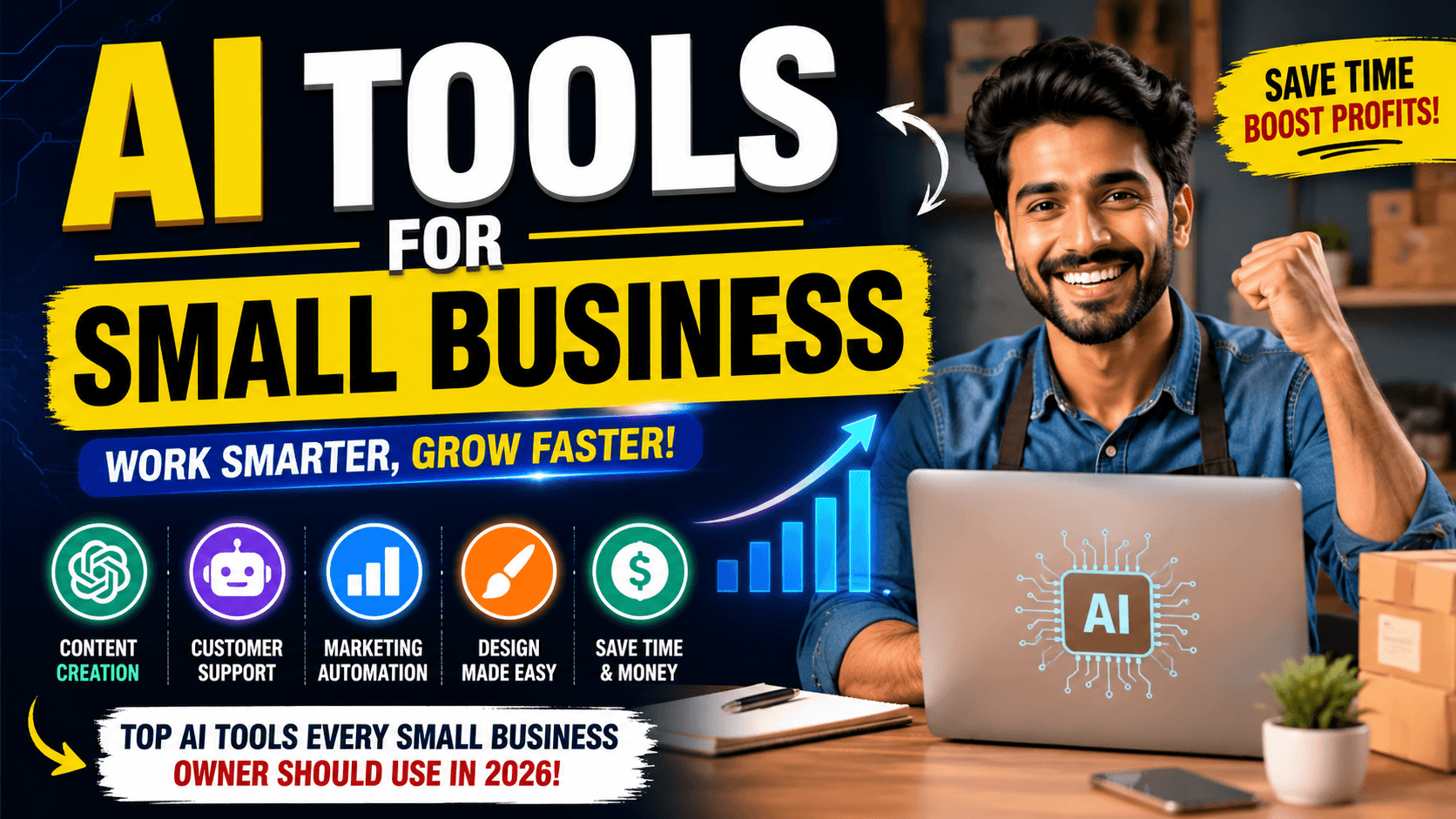
Discover the best AI tools for small business in 2026. From ChatGPT to Zapier, learn which tools save time, cut costs, and help small teams compete with bigger companies.
Quick Answer
The best AI tools for small business in 2026 include ChatGPT for writing and research, Jasper AI for marketing content, Canva Magic Studio for design, HubSpot for CRM, Zapier for automation, Tidio for customer service, Notion AI for project management, Grammarly for communication, Surfer SEO for content ranking, and QuickBooks for bookkeeping. A starter stack of two or three tools typically costs under $50/month and saves small businesses 12-15 hours per week on routine tasks.
Key Takeaways
- 68% of US small businesses now use AI regularly in 2026, up from 48% just two years ago
- Small businesses using AI tools save an average of 12-15 hours per week on routine tasks
- A practical starter stack (ChatGPT + Canva + HubSpot) covers most daily needs for under $50/month combined
- The average small business runs a median of five AI tools, with marketing leading adoption
- Cost savings of 20-30% in the first year are common once a tool stack is properly implemented
- Data privacy matters: check whether a tool trains its models on your business data before signing up
Why Every Small Business Needs AI Tools in 2026
The New Reality for Small Business Owners
Running a small business used to mean juggling everything by hand. Emails piled up, content took hours, customer questions waited overnight. Today, a quiet shift changes all of that. AI tools for small business now handle the heavy lifting - writing copy, answering customers, managing tasks - while owners focus on growth and relationships. What once needed a full team now gets done with a smart software stack costing less than a coffee per day.
Numbers tell the story clearly. According to a 2026 QuickBooks survey, 68 percent of US small businesses now use AI regularly, up from 48 percent just two years ago. Those same businesses report saving between 12 and 15 hours every week on routine tasks alone. Cost savings of 20 to 30 percent in the first year follow close behind. This is not a future trend - it already arrived. Small businesses that skip AI tools are competing with one hand tied behind their back.
The barrier dropped too. Tools that once cost thousands now start free or under twenty dollars a month. No coding skills required. No IT team needed. A solo founder today commands the same analytical power as a Fortune 500 company - just smarter software doing the work in the background. That playing field shift matters most to small teams that move fast and need results without waste.
What AI Tools Actually Do for a Small Business
Picture hiring five smart assistants who never sleep, never call in sick, and each specializes in one part of your business. One writes your blog posts. Another answers customer messages instantly. A third watches your bookkeeping for errors. A fourth schedules and posts on social media. The fifth spots problems in your data before they cost you money. That is what a modern AI tool stack does. Each tool fills a specific gap, and together they run your operations smoother than any single employee could.
The average small business in 2026 runs a median of five AI tools. Marketing leads adoption, followed by automation and customer service. Businesses building these stacks report 93 percent plan to keep investing, showing real returns rather than hype. What follows is a breakdown of the best AI tools across the most important categories - each chosen for ease of use, real-world value, and budget fit for small teams.
1. ChatGPT - The Best All-Purpose AI Assistant
Your Daily Business Brain
When people first discover AI tools for small business, ChatGPT usually comes first. And for good reason. Think of it as a smart generalist - one that drafts emails, brainstorms product ideas, writes job listings, summarizes long documents, and explains complex topics in plain language. Writer's block disappears. Research that took an hour takes five minutes. You are never staring at a blank page again.
The free version gives access to GPT-4o, powerful enough for most small business tasks. Paid plans start at twenty dollars a month and unlock deeper capabilities. Use it to create social media posts in seconds, reply to customer feedback professionally, or draft your next product launch email. The output is a solid first draft - faster than most employees, available any hour of the day.
Best for: Content drafts, email writing, research summaries, brainstorming, customer communication templates. Cost: Free tier available, Plus plan at $20/month.
2. Jasper AI - Best for Marketing Content at Scale
Your Brand Voice, Automated
Content marketing drives traffic, builds trust, and fills pipelines - but writing everything from scratch drains time fast. Jasper AI changes that. Train it on your brand voice, feed it your product details, and watch it generate blog posts, ad copy, social captions, and email campaigns that sound genuinely like you. Its standout feature, called Jasper IQ, learns your style and makes sure everything published sounds consistent across channels.
Small marketing teams using Jasper report cutting content creation time in half. If you spend ten or more hours weekly producing written content, that time shrinks dramatically. The output always needs a human review - fact-checking and fine-tuning still matter - but editing a strong first draft beats writing from zero every time. For a small business trying to compete with bigger content teams, Jasper closes the gap efficiently.
Best for: Blog posts, email campaigns, ad copy, social media content, product descriptions. Cost: Plans start from $39/month.
3. Canva Magic Studio - Best for Visual Design Without a Designer
Professional Graphics in Minutes
Good design builds trust. Poorly designed social posts, brochures, or ads signal amateurism before a single word gets read. Canva Magic Studio solves this for small businesses without design budgets. Its AI features generate complete social graphics, resize designs for every platform automatically, remove backgrounds from product photos instantly, and suggest layouts that match your brand colors. No design degree needed at all.
The tool handles Instagram posts, presentation slides, email headers, YouTube thumbnails, and even short video clips. Because everything stays on brand through saved templates and color palettes, consistency across all channels becomes effortless. Canva Pro is also one of the best-value AI tools on the market, making professional-looking output accessible to businesses with the tightest budgets.
Best for: Social media graphics, presentations, marketing materials, product images. Cost: Free tier available, Pro plan at $15/month.
4. HubSpot - Best Free CRM with Built-in AI
Know Your Customers, Grow Your Sales
Customer relationships are the backbone of every small business. HubSpot brings AI directly into managing those relationships - tracking leads, summarizing contact histories, scoring which prospects are most likely to buy, and even drafting follow-up emails automatically. When a customer reaches out, AI pulls up past conversations and context in seconds so your team never makes someone repeat themselves.
The free plan is remarkably generous, covering contact management, deal tracking, email tools, and basic automation without spending a dollar. Paid tiers unlock deeper AI features like predictive lead scoring and advanced reporting. For a small business where every customer counts, HubSpot turns scattered spreadsheets into an organized, intelligent system that actively helps close deals faster.
Best for: Lead tracking, customer management, sales pipeline, automated follow-ups. Cost: Free plan available, paid plans from $20/month.
5. Zapier - Best for Automating Repetitive Workflows
Connect Your Tools and Stop Doing Manual Work
Every small business has tasks that repeat daily - moving a new inquiry from a form into a spreadsheet, sending a welcome email when someone signs up, creating a follow-up task when a deal closes. Without automation, these eat hours every week. Zapier connects over 7,000 apps and lets you describe the automation you want in plain English. The AI builds the workflow. You confirm and switch it on.
One practical example: when a new lead submits a contact form, Zapier automatically adds them to your CRM, sends a personalized welcome email, and creates a follow-up task in your project management tool - all without anyone touching a keyboard. These small automations stack up fast. What used to take an hour of manual data entry happens instantly, accurately, every single time. For small teams stretched thin, Zapier acts as an invisible assistant running quietly in the background.
Best for: Workflow automation, app integrations, data routing, lead management. Cost: Free up to 100 tasks/month, Starter at $19.99/month.
6. Tidio - Best AI Chatbot for Customer Service
Answer Customers Instantly, Around the Clock
Customers expect instant replies. When no one is available overnight or on weekends, leads disappear and frustration builds. Tidio places an intelligent chatbot on your website that answers common questions immediately - order status, pricing, availability, return policies - without any human involved. It handles conversations naturally, escalates complex issues to real team members, and never misses an inquiry.
For e-commerce and service businesses especially, Tidio makes a measurable difference. Studies show businesses using AI chatbots see up to 70 percent of customer interactions resolved without human intervention. Response times that once stretched hours drop to seconds. Customer satisfaction climbs when answers arrive fast. A small team of three can deliver the customer experience of a company with a full support department - AI fills that gap quietly and efficiently.
Best for: Website live chat, FAQ automation, lead capture, e-commerce support. Cost: Free tier available, paid plans from $29/month.
7. Notion AI - Best for Team Knowledge and Project Management
Organize Everything, Remember Nothing by Hand
Scattered notes, lost meeting outcomes, unclear task ownership - small teams suffer these problems constantly. Notion with its built-in AI layer fixes all of it. Paste in a meeting transcript and ask it to extract every action item with the person responsible and the due date. Summarize a long document in three bullet points. Turn rough notes into a polished SOP. Generate a content calendar from a single paragraph description of your goals.
For solopreneurs and small teams alike, Notion becomes the central brain of the business. Templates for project tracking, CRM, content calendars, and wikis mean setup takes minutes rather than days. The AI layer makes that information instantly searchable and usable rather than sitting buried in a folder nobody opens. When operations run cleaner, execution speeds up and things stop falling through the cracks.
Best for: Internal documentation, project tracking, meeting notes, knowledge base, SOPs. Cost: Free for individuals, Plus plan at $10/user/month.
8. Grammarly Business - Best for Professional Written Communication
Every Message, Every Email, On Brand and Error-Free
First impressions in business often happen through written words - a proposal, a follow-up email, a social media comment. Typos, awkward phrasing, or an inconsistent tone chip away at credibility quietly. Grammarly Business goes far beyond spell-check. Its AI now assists with tone adjustments, rewrites entire sentences for clarity, and even generates full email drafts from bullet points inside Gmail, Outlook, Slack, and most browsers.
The Business tier adds a company style guide that enforces consistent brand voice across every employee's written output. Whether it is a sales proposal or a customer service reply, the AI keeps tone, terminology, and formality aligned automatically. For small businesses where a single email can win or lose a client, Grammarly acts as an invisible editor on every word sent out the door.
Best for: Email writing, proposals, customer replies, team-wide brand consistency. Cost: Free basic plan, Business plan at $15/user/month.
9. Surfer SEO - Best for Getting Found on Google
Content That Actually Ranks
Writing content is only half the battle. Getting it found on Google requires structure, keywords, and topical depth that match what the algorithm rewards. Surfer SEO scores your content in real time against the top twenty ranking pages for your target keyword. As you write, it tells you exactly which topics to cover, what questions to answer, and how long the article should be. Following its guidance dramatically improves chances of ranking on page one.
For a small business relying on organic search traffic, Surfer is one of the highest-return AI investments available. The 2026 version added an AI content audit tool that scans existing articles and identifies what needs updating to recover lost rankings. Rather than guessing why a page dropped in search results, Surfer pinpoints the exact issues and tells you how to fix them. Organic traffic grows when every piece of content is built on data, not intuition.
Best for: Blog SEO, content optimization, keyword research, ranking improvement. Cost: Plans from $99/month.
10. QuickBooks with Intuit Assist - Best for AI-Powered Bookkeeping
Keep Finances Clean Without an Accountant
Money is the lifeblood of a small business, and errors in bookkeeping can be costly. QuickBooks now includes Intuit Assist, an AI layer that categorizes transactions automatically, flags unusual spending, forecasts cash flow based on patterns, and flags potential tax issues before they become problems. Ask it a plain English question like which months were most profitable and it generates a clear answer instantly from your actual data.
For small business owners without an accounting background, this AI removes the intimidation from financial management entirely. Invoices get created and sent automatically. Expenses are sorted without manual input. Reports are ready for tax season without last-minute scrambling. Pair it with Zapier for automating bank feeds and the financial side of the business runs largely on its own, accurately and in real time.
Best for: Bookkeeping, invoicing, cash flow forecasting, expense tracking, tax prep. Cost: Plans from $30/month.
How to Build Your AI Tool Stack Without Overspending
Start Small, Scale Smart
The most common mistake small business owners make with AI tools is trying to use everything at once. Tool overload leads to nothing being used well. A smarter approach: pick two or three tools that solve your biggest daily pain points, get real results within the first week, and then add more gradually. The goal is not the most tools - it is the right tools working together.
A practical starter stack for most small businesses: ChatGPT for writing and research, Canva for design, and HubSpot for customer management. This three-tool stack covers the majority of daily needs and costs under fifty dollars a month combined, with free tiers making the entry point even lower. Once these three run smoothly and deliver clear time savings, add Zapier to connect them and automate the handoffs between tools. The integrations multiply value faster than adding new standalone tools ever would.
Always check data privacy before signing up. Some AI tools train their models on your business data, which means your customer information teaches their AI to serve competitors too. Ask vendors explicitly about data usage policies and export options before committing. The best tools make it transparent and easy to understand what happens to your information.
The Real ROI of AI Tools for Small Business
Numbers from 2026 research paint a clear picture of what AI tools deliver in practice. Small businesses adopting AI tools save an average of twelve to fifteen hours per week on routine tasks and reduce operational costs by 20 to 30 percent within the first year. 68 percent of US small businesses now use AI regularly, and 93 percent of those plan to keep investing because results are real and measurable.
Beyond efficiency, AI tools enable something harder to quantify but equally important: the ability for a small team to compete with much larger operations. A five-person business with the right AI stack can respond to customers faster, produce more content, manage more leads, and make smarter financial decisions than a twenty-person company running on manual processes. That competitive edge compounds over time as the tools learn more about the business and improve their outputs accordingly.
The question is no longer whether to use AI tools. The shift already happened. The question now is which tools fit your business best - and how quickly you start using them to close the gap with competitors who already have.
Conclusion
AI tools for small business in 2026 are not optional upgrades - they are the difference between running hard and running smart. From writing content to answering customers, managing money to ranking on Google, a well-chosen AI stack handles the work that used to eat your whole week. Start with one tool that solves your biggest problem today. Add another once that one delivers results. Build the stack gradually, connect the tools with automation, and watch operations run smoother month over month. The playing field leveled when AI became affordable. Now it is simply about who uses it better.
FAQs
1. What are the best AI tools for small business in 2026? The top AI tools for small business include ChatGPT for writing and research, Jasper AI for marketing content, Canva Magic Studio for design, HubSpot for CRM, Zapier for automation, Tidio for customer service, Notion AI for project management, Grammarly for communication, Surfer SEO for content ranking, and QuickBooks for bookkeeping. Starting with two or three of these delivers measurable results within the first week.
2. Are AI tools affordable for small businesses? Most leading AI tools for small business offer free tiers or plans under twenty dollars a month. AI infrastructure costs dropped roughly 60 percent between 2024 and 2026, making enterprise-level capabilities accessible to businesses of any size. A complete starter stack of three tools typically costs under fifty dollars monthly.
3. Do I need technical skills to use AI tools for small business? No technical background is required. Tools like Canva, ChatGPT, HubSpot, and Tidio are designed for non-technical users and can be operational within an hour of signing up. Zapier even lets you describe automations in plain English and builds the workflow for you automatically.
4. How much time can AI tools save a small business? Research from 2026 shows small businesses using AI tools save an average of 12 to 15 hours per week on routine tasks. Over a month that is 50 to 60 hours returned to strategy, sales, and relationship building instead of repetitive admin work.
5. Which AI tool should a small business start with? Start with the tool that solves your most painful daily problem. If content creation drains your time, begin with ChatGPT or Jasper. If customer service overwhelms your team, try Tidio. If your bookkeeping is messy, start with QuickBooks. Pick one, get real results, then expand the stack from there.
Amar Kumar
June 27, 2026
Related Posts

ai and automation
8 min readLatest AI News August 2026: OpenAI Astra, Price Cuts, 1 Billion Users & More
Latest AI news in August 2026: OpenAI's Astra model solves 10 unsolved math problems, ChatGPT crosses 1 billion users, GPT-5.6 Luna prices drop 80%, Google launches Gemini Robotics ER 2, and AI regulation tightens. Your complete weekly AI roundup.

ai and automation
7 min readAI Agents in 2026: How Autonomous AI is Replacing Traditional Automation
AI agents in 2026 are autonomous systems that plan, execute, and adapt across complex workflows. Discover how they differ from traditional automation and how businesses can start deploying them today.

ai and automation
9 min readNvidia's $250 Billion AI Bet: Inside the Global Race for AI Supremacy in 2026
Nvidia is reportedly considering a $250 billion financing guarantee tied to OpenAI's Ohio data center. The AI race in 2026 is no longer about models — it's about who controls the compute, power, and infrastructure. Here's what's happening.
Reader Response
What did you think?
Comments help us improve future articles.
146
0