

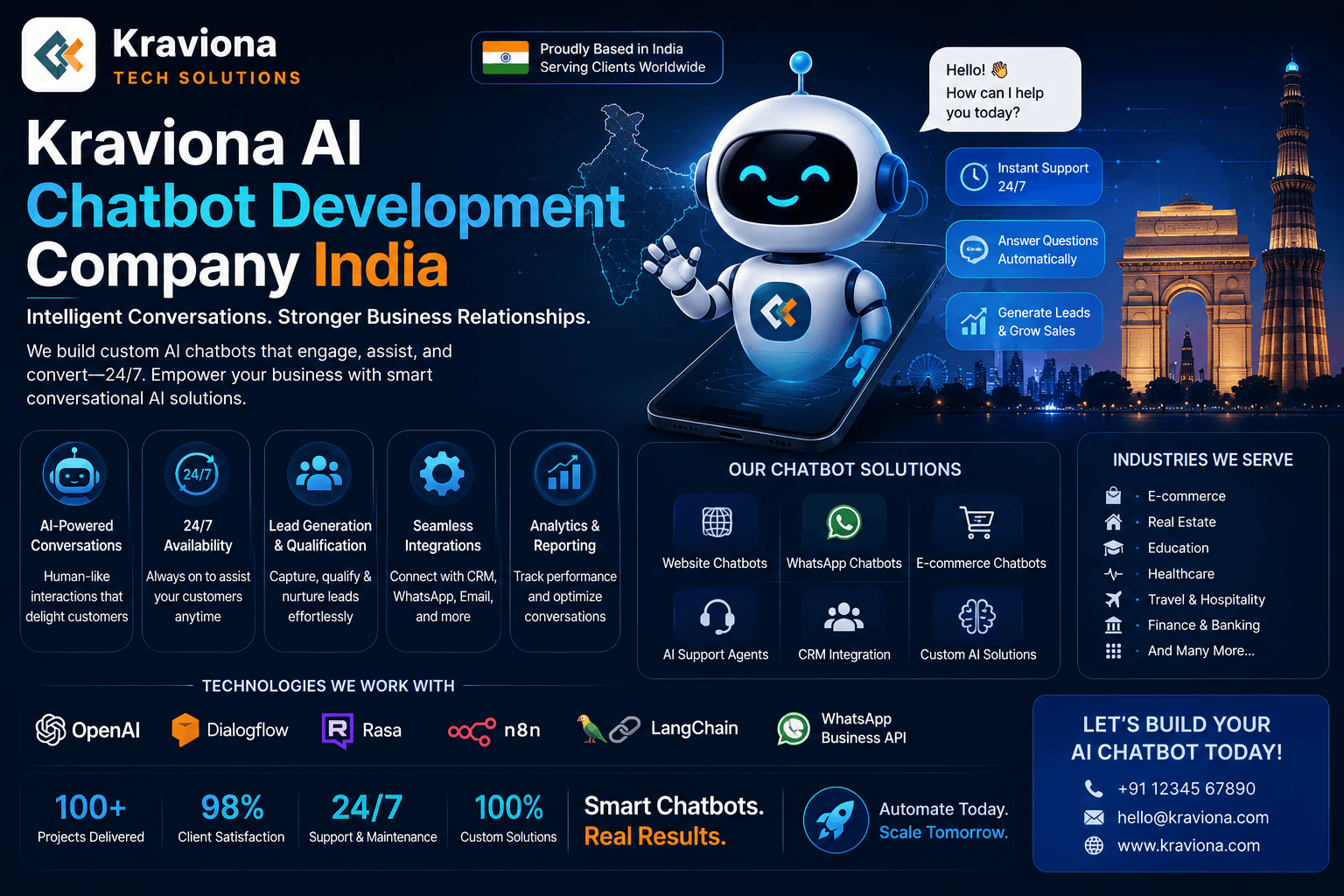
Hiring the wrong AI chatbot development company in India can cost you months and lakhs. This guide breaks down chatbot types, real costs in INR, production-grade architecture, Indian tool integrations…
Every missed WhatsApp message after business hours is a lead your competitor just picked up. Indian businesses lose thousands of potential customers every month - not because their product is weak, but because no one was available to respond at 11 PM. An AI chatbot built correctly does not just answer questions. It qualifies leads, books demos, processes Razorpay payments, and syncs data into your Zoho CRM, all without a single human in the loop.
This guide breaks down exactly what it takes to hire the right AI chatbot development company in India, what a production-grade chatbot actually costs, the technical architecture decisions that determine success or failure, and a no-nonsense vendor evaluation checklist you can use today.
What Does an AI Chatbot Development Company Actually Build?
The term "chatbot" covers a massive range of products - from a basic decision-tree bot that follows a script, to a fully autonomous AI agent that reads your product catalog, processes refunds, and escalates to a human agent only when genuinely needed. Before you hire anyone, you need to know which category your business requires.
Types of Chatbots by Capability
- Rule-based bots: Follow a fixed decision tree. Fast to build, but they break the moment a user asks something outside the script. Good only for very structured workflows like ticket booking or single-step FAQs.
- NLP-powered bots: Understand intent, not just keywords. Built on models like Dialogflow, Rasa, or fine-tuned transformer models. Handle natural language, spelling errors, and multiple intents in a single message.
- LLM-integrated bots: Use large language models (GPT-4, Gemini, Claude) with your own business data via RAG (Retrieval Augmented Generation). Answer questions from your product docs, policies, and knowledge base with high accuracy and natural language responses.
- Agentic bots: Do not just answer - they act. Book appointments in Google Calendar, raise invoices in Tally, send order updates via WhatsApp Business API, and update records in Zoho CRM without any human intervention.
Most Indian SMEs and startups need either a solid NLP bot or an LLM-integrated bot. The agentic tier is relevant for businesses with well-defined, high-volume workflows that currently require a dedicated ops or support team. For a broader picture of where chatbots fit in your automation stack, read our full breakdown on AI automation for Indian businesses.
AI Chatbot Development Cost in India - Actual Numbers
The market for chatbot development in India is full of wildly inconsistent pricing. A freelancer will quote Rs. 15,000 for something that fails in production within two weeks. An enterprise vendor will quote Rs. 25 lakhs for a product that a Rs. 3 lakh custom build could deliver. The table below reflects what real, production-ready chatbot builds actually cost.
| Chatbot Type | Tech Stack | Estimated Cost (INR) | Timeline | Best For |
|---|---|---|---|---|
| Rule-based FAQ Bot | Botpress / Landbot | Rs. 20,000 - Rs. 60,000 | 1-2 weeks | Simple lead capture, basic support |
| NLP Intent Bot | Dialogflow + Node.js | Rs. 80,000 - Rs. 2,50,000 | 3-5 weeks | E-commerce support, service booking |
| LLM-Integrated Knowledge Bot | OpenAI API + RAG + FastAPI | Rs. 2,50,000 - Rs. 6,00,000 | 5-8 weeks | B2B SaaS, EdTech, Legal, Finance |
| Full Agentic Chatbot | LangChain + Python + Custom APIs | Rs. 6,00,000 - Rs. 15,00,000+ | 8-14 weeks | Ops-heavy businesses, high-volume support |
| WhatsApp-First Bot (WABA) | WhatsApp Business API + Webhook | Rs. 1,50,000 - Rs. 4,00,000 | 3-6 weeks | D2C brands, local service businesses |
These figures represent build costs only. Factor in an additional 15 to 25 percent annually for hosting, LLM API usage, and ongoing maintenance. The LLM API cost for a mid-sized business handling 10,000 to 50,000 messages per month typically runs between Rs. 8,000 and Rs. 35,000 per month, depending on the model and average message complexity.
Technical Architecture of a Production-Grade AI Chatbot
Building a demo chatbot that works in a controlled environment is straightforward. Building one that handles 500 concurrent users, stays within your LLM token budget, and recovers gracefully from third-party API failures is an entirely different problem. This is where most cheap chatbot builds collapse within the first 90 days of going live.
Core Backend Components
A production-grade chatbot requires all of the following components working correctly together:
- API Gateway and Webhook Handler: Receives incoming messages from WhatsApp, your website widget, or your app. Normalizes payload formats before any processing begins.
- Session and Context Manager: Tracks conversation history per user. Without this layer, every message is treated as a fresh conversation with no memory of prior context. At Kraviona, we use Redis for this to handle high concurrency without session collisions or data loss.
- Intent Router: Determines which processing pipeline each message goes through - simple FAQ lookup, database query, LLM call, or human handoff trigger.
- Vector Database (for LLM bots): Stores embeddings of your product documentation, policies, and support articles. The bot retrieves only the most semantically relevant chunks before calling the LLM, keeping both costs and hallucination rates low.
- LLM Orchestration Layer: Manages prompts, context injection, retry logic, token counting, and fallback handling when the model returns a low-confidence or incomplete response.
- Integration Connectors: Connects the chatbot to Zoho CRM, Razorpay, Tally ERP, Google Calendar, or your internal database via REST or GraphQL APIs with proper authentication and error handling.
- Human Handoff Module: Detects frustration signals, repeated failed intents, or explicit escalation requests and routes the conversation to a live agent without losing any conversation history.
Frontend Deployment Options
- Website widget: Embedded via a lightweight JS snippet. Works on any stack including WordPress, Shopify, or custom Next.js builds.
- WhatsApp Business API: The highest-ROI channel for Indian B2C businesses. Requires a Meta-approved WABA number and a registered Business Solution Provider.
- Mobile app (in-app chat): For businesses with an existing Android or iOS app. Integrated via SDK or direct API calls from the app layer.
- Internal tools: For HR bots, IT helpdesks, or sales enablement bots used by your internal team inside Slack, Microsoft Teams, or a custom admin dashboard.
For MERN stack applications, we at Kraviona build the chatbot backend as a separate Python or FastAPI microservice and connect it to the Next.js frontend via a clean WebSocket or REST interface. This keeps the architecture decoupled and each layer independently scalable. See how we approach full-stack architecture in our guide on MERN stack development for Indian companies.
Chatbot Integration with Indian Business Tools
A chatbot that operates in isolation is worth half the value of one connected to the software your business already runs on. Indian businesses have a specific software ecosystem that most international chatbot platforms simply do not address. Custom integrations are not optional extras - they are what separate a working chatbot from a genuinely profitable one.
Critical Indian Software Integrations
- Razorpay: Accept payments, check payment status, and send payment links directly from within a chatbot conversation. High-value for D2C brands and service businesses where the customer journey should not leave the chat window.
- Tally ERP: Sync confirmed orders, generate GST-compliant invoices, and update inventory records without any manual data entry. Connects via Tally's TCP connector or a bridge API layer.
- Zoho CRM: Automatically create and update leads when the chatbot qualifies a prospect. Assign to the correct sales rep based on city or service type. Trigger follow-up email or WhatsApp sequences. This is where the measurable ROI of a well-built chatbot shows up most clearly.
- WhatsApp Business API: Send proactive messages - order confirmations, appointment reminders, payment follow-ups, restock alerts - not just respond to inbound queries. This transforms a reactive support tool into a revenue-generating communication channel.
- Google Workspace: Book appointments in Google Calendar, send confirmation emails via Gmail, and update Google Sheets for smaller businesses not yet on a formal CRM.
If you want to understand the full automation potential beyond chatbots, our guide on AI tools built specifically for Indian small businesses covers the broader stack. If you are already experimenting with large language models for business tasks, our article on how to use ChatGPT effectively for business operations covers practical, deployable patterns you can act on today.
Common Mistakes When Hiring an AI Chatbot Company in India
Most chatbot projects in India fail not because the technology does not work, but because of poor vendor selection, vague project scoping, and expectations set by agencies more interested in closing a deal than delivering a working product.
Mistake 1 - Choosing a SaaS Platform Without Evaluating Custom Builds
Platforms like Intercom, Tidio, and ManyChat are genuinely excellent for certain use cases. But if you have custom workflows, non-standard data sources, or specific integrations such as Tally or a proprietary ERP, a no-code platform will hit its capability ceiling quickly. Get a proper technical evaluation comparing both options before committing to either.
Mistake 2 - Starting Development Without a Defined Conversation Scope
The most common cause of chatbot project overruns in India is scope that was never properly defined. "The bot should handle customer support" is not a scope. "The bot should handle 18 specific support intents defined in this specification document, escalate all others to human agents within 30 seconds, and sync resolved tickets to Zoho Desk" - that is a scope. Demand a functional specification document before any development begins.
Mistake 3 - Treating Conversation Design as a Developer Task
Writing chatbot dialogue is not the same as writing website copy. The flow must account for broken messages, typos, mid-conversation topic switches, users who go silent, and users who circle back to earlier points. Most backend developers do not have conversation design skills. The best chatbot companies have a dedicated process for this work.
Mistake 4 - Declaring the Project Complete at Go-Live
An NLP or LLM chatbot improves with real conversation data. The first four weeks of live deployment always reveal gaps in intent coverage, knowledge base accuracy, and edge cases that no amount of pre-launch testing fully anticipates. Budget for at least four weeks of post-launch monitoring and model retraining. Any vendor who says the bot is finished when it launches is not giving you honest advice.
Mistake 5 - Making WhatsApp an Afterthought
For Indian B2C businesses, WhatsApp is not one channel among several - it is the primary channel. A chatbot deployed only on your website misses the platform where the majority of your customers are most responsive. If your target customers are in Delhi, Mumbai, Hyderabad, Pune, or any Tier 2 city, WhatsApp deployment is not optional.
For context on how AI-driven companies in Delhi approach automation at scale, read our piece on top AI automation companies based in Delhi.
How Kraviona Builds AI Chatbots
At Kraviona Tech Solutions, every chatbot project runs in strict 2-week sprints. No waterfall delivery. No 3-month silence followed by a rushed handover. You see working, testable software at the end of every sprint and you can redirect priorities based on what you see.
Our 5-Phase Chatbot Delivery Process
- Discovery Sprint (Weeks 1 to 2): We map your current support or sales workflow end-to-end, identify the top 20 to 30 use cases by volume, define escalation logic, and audit your existing tech stack for integration points. Deliverable - a functional specification document that you own regardless of what happens next.
- Architecture and Stack Selection (Weeks 2 to 3): Based on your message volume, budget, and integration requirements, we select the right stack - NLP-only, LLM-augmented with RAG, or full agentic. We document the architecture and get your sign-off before writing a single line of production code.
- Core Build Sprint (Weeks 3 to 6): Backend development runs in parallel with conversation design. The intent model and knowledge base are built simultaneously with the API layer and integration connectors, reducing total build time without sacrificing quality.
- Integration and Testing Sprint (Weeks 6 to 8): Connect all third-party integrations. Run load testing, edge case testing, and adversarial prompt testing to verify the bot does not hallucinate, loop indefinitely, or break under unusual inputs.
- Deployment and Monitoring (Week 8 onwards): Launch on all agreed channels. Monitor conversation logs daily for the first four weeks. Retrain the model on real user data. Deliver a monthly performance report covering deflection rate, escalation rate, response accuracy, and identified coverage gaps.
Post-deployment support is a contractual deliverable at Kraviona - not an optional upsell. We are a 100 percent in-house team with no outsourcing, which means the engineer who designed your chatbot architecture is the same person available when something breaks in production.
Key Takeaways
- AI chatbot costs in India range from Rs. 20,000 for rule-based bots to Rs. 15 lakhs or more for full agentic systems. Choose the right tier for your actual use case.
- WhatsApp Business API integration is non-negotiable for any Indian B2C chatbot deployment. It is where your customers are most responsive and most likely to convert.
- Production-grade chatbots require Redis-backed session management, a vector database for LLM bots, and proper human handoff logic - not just an API call to GPT wrapped in a chat widget.
- Define your conversation scope completely in a written functional specification before any development begins. Undefined scope is the single biggest cause of chatbot project failure in India.
- Post-launch retraining is not optional. Budget for at least four weeks of monitoring and model improvement after go-live.
Frequently Asked Questions
AI chatbot development company India mein hire karne mein kitna kharcha aata hai?
Cost chatbot ke type par depend karta hai. Rule-based FAQ bot Rs. 20,000 se Rs. 60,000 mein ban jaata hai. NLP intent bots Rs. 80,000 se Rs. 2.5 lakh tak. LLM-integrated bots with RAG Rs. 2.5 lakh se Rs. 6 lakh tak. Full agentic systems Rs. 6 lakh se Rs. 15 lakh tak. WhatsApp-first bots generally Rs. 1.5 lakh se Rs. 4 lakh ke beech hote hain. In build costs mein hosting aur API usage charges alag hote hain.
WhatsApp chatbot aur website chatbot mein kya fark hai?
Website chatbot ek JS widget hota hai jo aapki site par embed hota hai. WhatsApp chatbot Meta ke approved WABA number ke through kaam karta hai aur proactive messages bhi bhej sakta hai - sirf inbound queries ka respond nahi karta. Indian B2C businesses ke liye WhatsApp channel almost always higher ROI deta hai kyunki customers wahan already active rehte hain.
Kya chatbot Tally aur Razorpay ke saath integrate ho sakta hai?
Haan. Tally integration Tally ke TCP connector ya third-party bridge API ke through hoti hai. Razorpay integration REST API ke through straightforward hai - payment links generate karna, status check karna, aur refund trigger karna sab chatbot ke andar handle ho sakta hai. Yeh integrations custom development require karti hain - off-the-shelf platforms mein natively available nahi hoti.
LLM chatbot aur normal NLP chatbot mein difference kya hota hai?
NLP chatbot predefined intents par kaam karta hai - agar user kuch aisa puchhe jo training data mein nahi hai toh bot fail karta hai. LLM chatbot (GPT, Gemini, etc. using) natural language genuinely samajhta hai aur aapke documents aur policies se answers generate karta hai. LLM bots zyada flexible hain lekin API costs aur architecture complexity bhi zyaada hoti hai.
Chatbot project kitne time mein complete hota hai?
Simple rule-based bot 1-2 weeks mein. NLP bot 3-5 weeks. LLM-integrated knowledge bot 5-8 weeks. Full agentic chatbot 8-14 weeks. Timeline directly depend karta hai integrations ki complexity par aur conversation scope ki clarity par.
Post-launch mein chatbot ko maintain karna padhta hai kya?
Haan, aur yeh non-negotiable hai. Real conversations se nayi intents surface hoti hain aur knowledge base mein gaps milte hain. Minimum 4 weeks ka post-launch monitoring aur retraining budget mein rakhna chahiye. Kraviona mein yeh post-deployment support contractually included hoti hai, alag cost par nahi.
Kraviona se chatbot banwane ke liye contact kaise karein?
Aap seedha email kar sakte hain kravionatech@gmail.com par ya call kar sakte hain +91 88251 61664 par. Pehli scoping call free hoti hai jisme hum aapke use case ko assess karte hain aur honestly batate hain ki custom build chahiye ya koi existing platform kaam kar sakta hai.
Start Your Chatbot Project
If you are evaluating an AI chatbot development company in India and want a straight technical assessment of what your specific use case actually needs - not a sales pitch - reach out to us at Kraviona Tech Solutions. We will scope your project honestly, tell you which tier of chatbot fits your business, and give you a fixed-scope estimate before any contract is signed.
Email us at kravionatech@gmail.com or call directly at +91 88251 61664. For more on how we approach AI-driven business transformation, read our guide on choosing the right AI automation agency in India.
Amar Kumar
July 18, 2026
Reader Response
What did you think?
Comments help us improve future articles.
2
0