

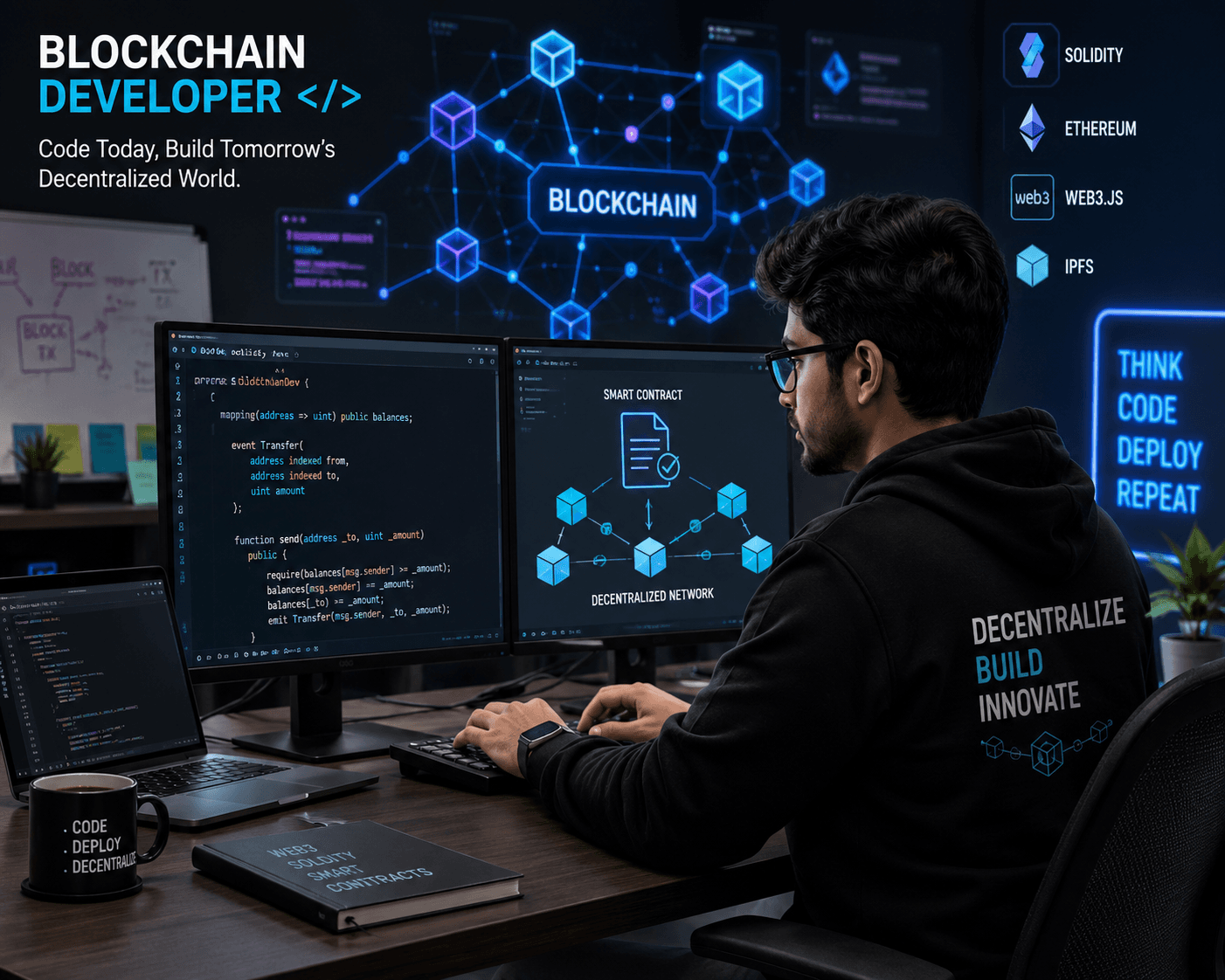
A complete guide to becoming a blockchain developer in 2026 — skills, salary, roadmap, tools, job roles, and expert tips to launch your Web3 career.
Blockchain Developer: Complete Career Guide for 2026
Blockchain technology is no longer just about cryptocurrency. In 2026, it powers decentralized finance (DeFi), supply chain transparency, healthcare records, digital identity, gaming, and enterprise automation. At the center of all this innovation is the blockchain developer — one of the most in-demand and well-paid tech professionals in the world.
This guide covers everything you need to know: what blockchain developers do, what skills you need, how to learn them, salary expectations, job roles, career roadmap, and answers to the most common questions.
What is a Blockchain Developer?
A blockchain developer is a software engineer who specializes in designing, building, and maintaining blockchain-based applications and infrastructure. They work with decentralized networks, write smart contracts, build decentralized applications (dApps), and integrate Web3 technologies into real-world products.
1. Core Blockchain Developer
Core developers build and maintain the blockchain protocol itself — the architecture, consensus mechanisms, network security, and the foundational layer.
2. Blockchain Software Developer (dApp Developer)
These developers build decentralized applications on top of existing blockchains like Ethereum, Solana, or Polygon. They write smart contracts, build front-end interfaces, and integrate wallets and APIs.
What Does a Blockchain Developer Do?
- Design and deploy smart contracts on Ethereum, Solana, BNB Chain, or Polygon
- Build decentralized applications (dApps) with Web3 front-end interfaces
- Integrate crypto wallets (MetaMask, Phantom, WalletConnect)
- Write and audit smart contract code for security vulnerabilities
- Work with blockchain APIs and oracles (Chainlink)
- Implement tokenomics and NFT standards (ERC-20, ERC-721, ERC-1155)
- Optimize gas fees and transaction throughput
- Stay current with blockchain protocol upgrades and ecosystem trends
Essential Skills for Blockchain Developers in 2026
Programming Languages
- Solidity — Primary language for Ethereum smart contracts
- Rust — Required for Solana development
- JavaScript / TypeScript — Core for Web3 front-end
- Python — Scripting and blockchain backends
- Go (Golang) — Used in Hyperledger Fabric
Web3 Libraries and Frameworks
- Ethers.js — Lightweight Ethereum library (preferred in 2026)
- Hardhat — Smart contract development and testing
- Foundry — Fast Rust-based smart contract toolkit
- wagmi + viem — Modern Ethereum React hooks
- Anchor — Framework for Solana smart contracts
Blockchain Concepts You Must Know
- Consensus mechanisms: Proof of Work, Proof of Stake
- Cryptography: Hash functions, public/private keys, digital signatures
- Smart contract security: Reentrancy, overflow, access control vulnerabilities
- Layer 2 solutions: Optimism, Arbitrum, zkSync, Polygon zkEVM
- Tokenomics and token standards (ERC-20, ERC-721, ERC-1155)
- DeFi protocols: AMMs, lending protocols, yield farming
- Gas optimization techniques
Blockchain Developer Roadmap 2026
Phase 1 — Foundation (0–3 Months)
- Learn JavaScript thoroughly (ES6+, async/await)
- Understand how blockchain works: blocks, chains, nodes, consensus
- Learn cryptography basics: hashing, public key cryptography
- Study Bitcoin and Ethereum whitepapers
- Set up MetaMask, interact with testnets (Sepolia, Mumbai)
Phase 2 — Smart Contract Development (3–6 Months)
- Learn Solidity from basics to advanced patterns
- Write and deploy ERC-20 and ERC-721 contracts
- Use Hardhat or Foundry for local development and testing
- Learn smart contract security — study common vulnerabilities
- Build 3–5 small projects: token, NFT contract, simple DEX
Phase 3 — dApp Development (6–9 Months)
- Connect smart contracts to React front-end using ethers.js or wagmi
- Integrate MetaMask and WalletConnect
- Build a full dApp: frontend + smart contract + wallet connection
- Learn IPFS for decentralized storage
- Use The Graph to query on-chain data efficiently
Phase 4 — Specialization (9–12 Months)
- DeFi: AMMs, lending protocols, staking contracts
- NFTs: Marketplaces, royalties, metadata standards
- Layer 2: zkRollups, Optimistic Rollups development
- Solana: Rust + Anchor framework
- Security/Auditing: Smart contract audit techniques
Phase 5 — Portfolio and Jobs (Ongoing)
- Build 2–3 strong portfolio projects on GitHub
- Contribute to open source Web3 projects
- Join hackathons (ETHGlobal, Solana Hacker House)
- Network in Discord communities and Twitter/X crypto spaces
Blockchain Developer Salary in 2026
India
| Experience Level | Annual Salary (INR) |
|---|---|
| Fresher (0–1 year) | ₹6 – ₹12 LPA |
| Junior (1–3 years) | ₹12 – ₹25 LPA |
| Mid-level (3–5 years) | ₹25 – ₹50 LPA |
| Senior (5+ years) | ₹50 – ₹1.2 Cr+ LPA |
Global / Remote
| Experience Level | Annual Salary (USD) |
|---|---|
| Junior | $70,000 – $110,000 |
| Mid-level | $110,000 – $160,000 |
| Senior | $160,000 – $250,000+ |
| Freelance / Contract | $100 – $300/hour |
Top Job Roles in Blockchain Development
- Smart Contract Developer — Writes and audits Solidity/Rust contracts
- Web3 Full Stack Developer — Builds complete dApps front-end to contract
- DeFi Protocol Developer — Builds lending, AMM, and yield protocols
- NFT Platform Developer — Builds minting platforms and marketplaces
- Smart Contract Security Auditor — Audits contracts for vulnerabilities
- Core Protocol Developer — Works on L1/L2 blockchain codebases
- Blockchain Solutions Architect — Designs enterprise blockchain systems
Top Companies Hiring Blockchain Developers in 2026
- Web3 Native: Uniswap, Aave, OpenSea, Chainlink, Alchemy, ConsenSys
- Big Tech: Microsoft, IBM, Amazon (AWS Blockchain), Salesforce
- Finance: JPMorgan, Goldman Sachs, Visa, Mastercard, HDFC, ICICI
- Indian Startups: Polygon, CoinDCX, WazirX, Mudrex, Biconomy
- Consulting: Deloitte, Accenture, Wipro, Infosys
Best Resources to Learn Blockchain Development
- CryptoZombies — Gamified Solidity learning platform
- Ethereum.org Developer Docs — Official comprehensive documentation
- Patrick Collins YouTube — Most complete free Web3 course (32+ hours)
- LearnWeb3 DAO — Structured free curriculum
- Ethernaut — OpenZeppelin smart contract security CTF
- Damn Vulnerable DeFi — DeFi hacking challenges
- ETHGlobal Hackathons — Build real projects under pressure
Is Blockchain Development a Good Career in 2026?
- High demand, low supply: Far more blockchain jobs than qualified developers globally
- Remote-first culture: Most Web3 companies are fully remote and hire globally
- Premium salaries: Blockchain developers earn significantly more than average software engineers
- Early mover advantage: The ecosystem is still maturing — entering now means growing with it
- India opportunity: Indian developers increasingly sought after for global Web3 roles
Frequently Asked Questions
Can I become a blockchain developer without a CS degree?
Yes. Many top blockchain developers are self-taught. What matters is your GitHub portfolio, your understanding of smart contracts, and your ability to build real dApps.
How long does it take to become a blockchain developer?
With consistent effort (4–6 hours/day), you can be job-ready in 9–12 months. If you already know JavaScript, this timeline can be 6–8 months.
Which blockchain should I learn first — Ethereum or Solana?
Start with Ethereum. It has the largest developer community, the most resources, and Solidity is the most documented smart contract language.
Is blockchain development only for crypto projects?
No. Blockchain is used in supply chain, healthcare, real estate, digital identity, voting systems, and enterprise automation. Crypto is just one application.
Do I need to invest in crypto to become a blockchain developer?
No. You can learn, build, and work in blockchain development without investing any money in cryptocurrency. Testnets provide free test tokens.
What is the future of blockchain development beyond 2026?
Mass adoption of Layer 2 networks, real-world asset tokenization, AI + blockchain integration, and enterprise blockchain systems replacing legacy infrastructure. Demand for skilled developers will continue rising.
Conclusion
Blockchain development is one of the most rewarding and future-proof technology careers available today. High salaries, remote work opportunities, global demand, and the chance to build genuinely transformative technology make it a compelling path for any developer.
Start with JavaScript and Ethereum fundamentals, build your first smart contract within a month, and deploy your first dApp within six months. The Web3 ecosystem rewards builders — so start building today.
Amar Kumar
July 18, 2026
Reader Response
What did you think?
Comments help us improve future articles.
3
0