

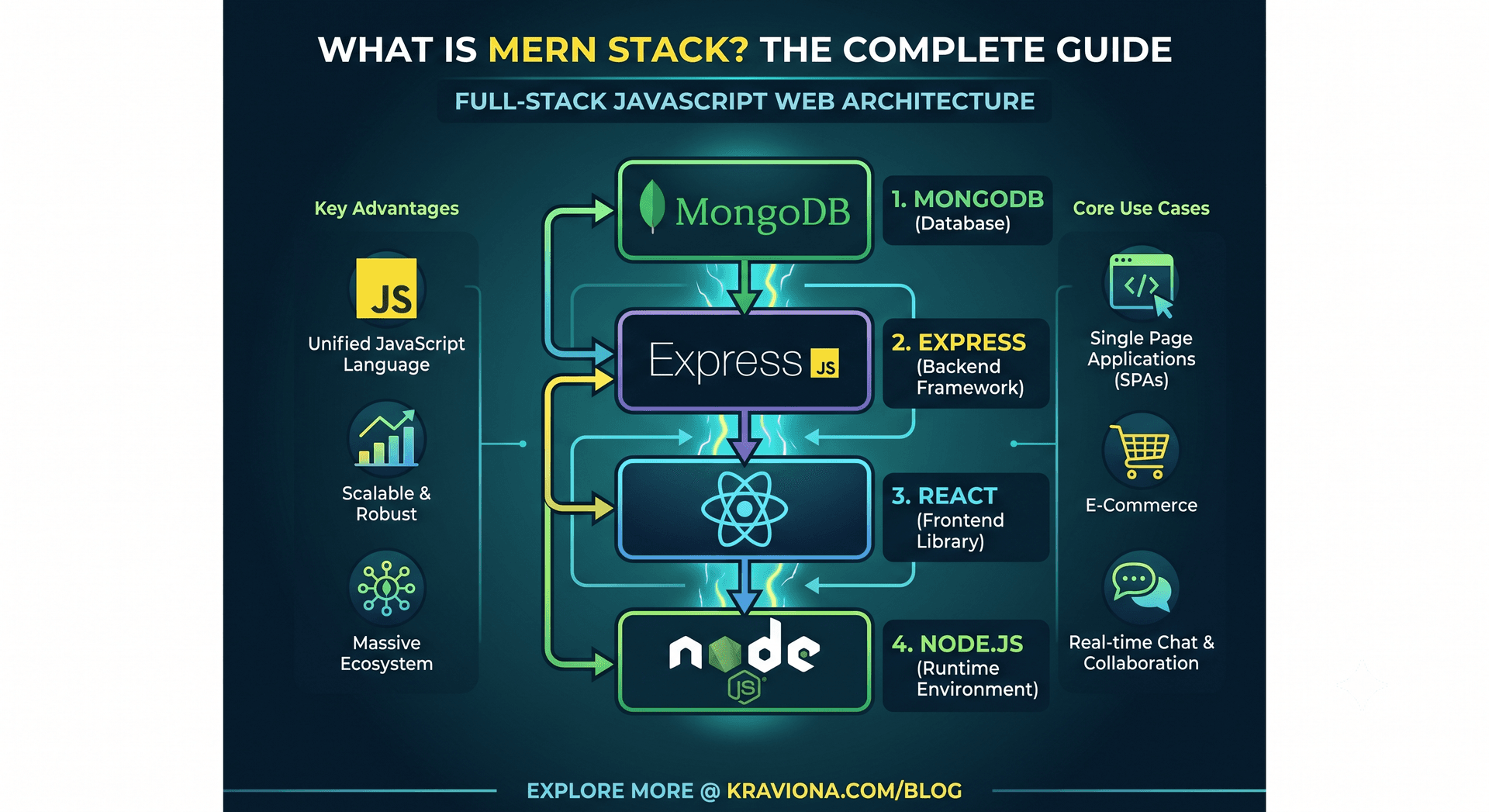
What is MERN Stack? The Complete 2026 Guide for DevelopWondering what is MERN stack and how it powers modern web apps? Discover the complete breakdown, benefits, and real-world examples. Read now!
If you are trying to break into the fast-moving world of software engineering, your very first question is bound to be: what is mern stack and why does every tech startup want to hire people who know it? In 2026, web development is all about speed, efficiency, and writing clean, reusable code. Because of this, frameworks that let you use a single programming language across an entire project have completely taken over.
The MERN ecosystem is the absolute leader of this movement. Whether you are a fresh developer trying to build your first real full-stack web application, or a business founder aiming to launch a massive digital product, mastering this stack is a total game-changer. At Kraviona Tech Solutions, a premier website development company in Delhi NCR, we use this technology every single day to build highly secure, enterprise-grade platforms for our clients.
In this ultimate guide, we are going to pull back the curtain. We will break down exactly how these tools connect, trace how data moves through a live application, and highlight the subtle architectural traps you need to look out for.
TL;DR: A Quick Overview
- MongoDB: A modern, flexible database that drops rigid rows and tables for fast, document-based JSON storage.
- Express.js: A simple, minimalist backend web framework built directly on top of Node.js.
- React.js: An interactive frontend library built by Meta that makes creating dynamic, modular user interfaces incredibly smooth.
- Node.js: A heavy-duty, cross-platform JavaScript runtime engine that executes backend code right on your server.
- The Core Secret: You only need to master one language—JavaScript—to manage your entire application from front to back.
What is MERN Stack? The Core Architecture Broken Down
To give a proper answer to the question of what is mern stack, we need to dissect its four main components. The name itself is an acronym made from MongoDB, Express, React, and Node. Together, they combine to create a beautifully structured, three-tier software architecture: the client tier (frontend), the application tier (backend), and the data tier (database).
The magic happens because every single layer of this system communicates natively using JavaScript and JSON. This means data moves from your server to your database and straight onto a user’s laptop screen without needing complex, slow data conversion tools. Let's look closer at each component.
MongoDB: Storing Data Without the Headache
MongoDB represents the data tier of your application. Traditional databases, like MySQL, force you to set up highly rigid tables, columns, and rows before you can even think about saving a single piece of user data. MongoDB throws that old playbook away. It is a NoSQL, document-oriented database that stores information in highly flexible, JSON-like formats called BSON.
This document-centric model makes updating your application incredibly easy. Imagine you run an application and suddenly need to add an alternate phone number or a new social media handle to your user profiles. Instead of running a risky database migration that could bring your entire site down, you simply insert the new field directly into that user's document.
Take a look at how clean a standard user profile looks in MongoDB:
JSON
Because this layout looks exactly like normal JavaScript object notation, your backend reads and writes to it instantly. If you want to see how global tech giants leverage this database to scale to millions of users, check out the official documentation on the MongoDB website.
Express.js: The Intelligent Middleware Gateway
Express.js serves as the backbone of your application tier. While Node.js gives you the raw capability to run JavaScript code on a computer server, writing an entire web framework from scratch using basic Node functions is incredibly tedious and time-consuming.
That is where Express steps in. It is a minimalist, fast web framework designed to handle all your routing, server logic, and API endpoints. It stands directly between your user interface (React) and your core data records (MongoDB), handling incoming client requests and sending back appropriate answers.
Whenever you want to build clean RESTful APIs to connect different services, Express makes it incredibly easy. For example, if you want to look at how businesses leverage this runtime for enterprise services, exploring modern Node.js development services will show you how robust a custom Express server can really be.
React.js: Crafting Dynamic, Lightning-Fast UIs
React.js is the component that handles what your users actually see and touch. Originally designed by engineers at Meta, React completely changed how frontend development works by pioneering a component-driven architecture.
Instead of writing monolithic, messy HTML pages that are thousands of lines long, React lets you break your user interface down into tiny, modular pieces. You can build an independent Header component, a ProductCard component, and a CheckoutForm component, then fit them together perfectly. You can learn more about its internal mechanics directly via the official React documentation.
On top of that, React uses a concept called the Virtual DOM. When someone clicks a button or updates their profile, React computes the exact difference between the old screen and the new screen. It then updates only the specific elements that actually changed, rather than forcing the entire webpage to reload. This gives users the smooth, instantaneous feel of a native mobile app. For companies looking to build cutting-edge frontends, incorporating expert React development services is the fastest way to elevate user retention.
Node.js: Taking JavaScript Out of the Browser
Rounding out the stack is Node.js. A common mistake beginners make is thinking Node is a programming language or a framework. In reality, it is a lightweight, highly efficient JavaScript runtime environment. Powered by Google Chrome’s ultra-fast V8 engine, Node allows developers to execute JavaScript code straight on a server machine.
Before Node launched, JavaScript was essentially trapped inside web browsers. If you wanted to write code to connect to a server or talk to a database, you had to learn completely different programming languages like PHP, Python, or Java. Node altered the course of tech history by allowing developers to use their front-end JavaScript skills to build high-performance back-end systems. You can read up on its incredible processing power on the Node.js foundation portal.
How Does the MERN Stack Work? A Real-World Walkthrough
Understanding the abstract definitions of what is mern stack is helpful, but seeing how these four technologies work together in harmony is where the real clarity comes. Let’s walk through a routine, real-world example: a user logging into a private customer dashboard.
Step 1: React Captures the Action
Everything begins in the user's web browser. The customer pulls up your login page and interacts with a sleek web form built with React. They fill in their email address and secure password, then hit "Submit."
Behind the scenes, React immediately intercepts that click event. It collects the text fields from the form, packages them neatly into a secure JSON data packet, and uses an HTTP library to shoot an asynchronous request across the internet to your backend API.
Step 2: Express Decodes and Evaluates
The data packet arrives at your cloud server running Node.js. Your Express application is constantly running in the background, listening for incoming requests on a specific path—like /api/v1/auth/login.
Express takes the request, reads the incoming JSON payload, and begins running your backend business logic. It checks to ensure the email is formatted properly and that the request isn’t coming from a malicious bot. Once the initial validations clear, Express gets ready to check the secure records.
Step 3: MongoDB Fetches the Secure Record
Express opens up a quick channel to your database tier. It asks MongoDB to look through its collection of users and pull up the specific document that matches the email address the customer just typed in.
MongoDB scans its indexed records, locates the exact document in milliseconds, and hands it right back to Express. Express then runs a background security check, comparing the password string typed by the user against the heavily encrypted password string stored safely in your database.
Step 4: Node Delivers the Response
If the credentials check out perfectly, Express issues a secure, encrypted digital token. It packages this token into a success response, and Node transmits it back over the web to the browser.
React receives the success response, securely stores the authorization token in the browser's local memory, and instantly updates the visual interface to display the user's dashboard. The user never sees a messy page refresh; everything happens smoothly and immediately.
The Real Reasons Why What is MERN Stack Dominates in 2026
If you survey modern software agencies and tech teams, you will find an overwhelming preference for this specific setup. Let’s look at the actual business and technical advantages that make it a premier choice for modern MERN stack development.
1. The Power of Full-Stack JavaScript
The absolute biggest advantage of using this stack is having one cohesive programming language across your entire engineering team. Historically, companies had to hire separate backend specialists who wrote in Java or Python, and frontend specialists who wrote in JavaScript.
With MERN, that divide disappears completely. A single engineer can hop from designing a UI button in React to writing a database aggregation query in MongoDB without facing any mental friction or context-switching. This dramatically lowers your total development time and slashes hiring costs for startups.
2. A Massive Open-Source Ecosystem (NPM)
Because millions of software engineers around the globe use Node and React daily, the collective ecosystem is massive. Through the Node Package Manager (NPM), you gain instant access to millions of free, open-source code libraries that you can drop straight into your app.
Need to connect to a payment processor like Stripe? Want to add complex multi-factor authentication? Looking to generate automated PDF invoices? Someone has already written, tested, and optimized a package for it. This allows your team to skip writing foundational boilerplate code and focus entirely on building core features.
3. Asynchronous Speed and High Concurrency
Node.js operates on an event-driven, non-blocking I/O model. In simple terms, instead of getting bogged down when thousands of users connect at the exact same moment, Node handles requests asynchronously. This makes it an absolute powerhouse for modern, data-heavy web applications that require real-time updates, such as instant messaging platforms, live auction sites, or collaborative workspaces.
4. Seamless, Budget-Friendly Cloud Deployment
Deploying modern applications has never been more straightforward or reliable. You can split your stack to achieve optimal performance: deploy your front-end React code to global content delivery networks like Vercel, and run your Express API on modern cloud services like Render. Combined with a managed database service like MongoDB Atlas, your application gains incredible security and global availability right out of the box.
Practical Examples: What Can You Actually Build?
To truly appreciate the versatility of this framework, let's explore the types of digital products where this architecture delivers the absolute best results.
High-Performance Web Applications
If you are planning an application where users log in, manage data, track analytics, or view customized dashboards, this stack handles it perfectly. For complex systems, partnering with professional web app development services ensures your database indices and server memory are properly structured from day one.
Scalable E-Commerce Platforms
Online retail requires managing fluid product catalogs, inventory tracking, and swift checkouts. MongoDB's schema-less document design is perfect for e-commerce, where a pair of shoes has vastly different specifications (size, material) than a smartphone (RAM, storage, battery). React handles the shopping cart updates instantly, offering a seamless user experience.
Real-Time Streaming and Collaboration Tools
Because Node.js excels at managing continuous, open data sockets, it is the premier choice for building collaborative platforms. Whether you are creating a live project management application, a customer support chat channel, or a multiplayer dashboard, MERN keeps data synced across all connected devices instantly. If you are learning how to build these step-by-step, take a look at our ultimate MERN stack developer roadmap for 2026.
Mistakes You Must Avoid When Building MERN Applications
Even the most powerful tools can fail if they are implemented incorrectly. If you are architectural planning or coding your next major project, make sure to steer clear of these incredibly common traps.
1. Relying Solely on Frontend Form Validation
A classic mistake beginners make is assuming that because their React form requires a strong password or a valid email, their backend is safe. Malicious actors can easily bypass your user interface entirely and send raw, harmful HTTP requests directly to your Express server. You must always enforce strict schema validation on your backend server using validation libraries like Joi or Zod before allowing data to interact with MongoDB.
2. Completely Ignoring Technical SEO
Because basic React applications are client-side rendered (CSR), the server sends a nearly empty HTML file to the browser, and JavaScript builds the page on the fly. While this is great for user experience, search engine web crawlers sometimes struggle to read and index your content properly. If your business depends on organic search traffic, implementing server-side solutions or working alongside an agency specializing in Technical SEO services is absolutely mandatory to make sure your pages rank high on Google.
3. Creating Deeply Nested Database Documents
It is easy to abuse MongoDB’s flexible nature by nesting endless arrays inside a single document. For example, if you build a forum and nest every single user comment inside one main topic document, you will eventually hit MongoDB's strict 16MB document size limit as your site grows. Learn how to design clean document relationships, use references properly, and leverage database indexing to keep your queries lightning fast.
Frequently Asked Questions (FAQ)
Here are the direct answers to some of the most common questions people ask about this development framework.
Is MERN stack good for beginners?
Yes, it is arguably the best full-stack ecosystem for beginners. Because it relies entirely on JavaScript, you don't have to learn two or three different languages at the same time just to connect a frontend to a database. It allows you to master full-stack software concepts quickly using a single language syntax.
Is MERN stack still relevant in 2026?
Absolutely. In 2026, the JavaScript and React ecosystems are stronger and more stable than ever. It remains the dominant framework for modern startups, scaling software companies, and enterprise IT agencies who need to build, test, and deploy resilient web platforms quickly.
What is the difference between MEAN and MERN stack?
The only real difference lies in the frontend tier. The MEAN stack utilizes Angular (built and backed by Google), while the MERN stack uses React (built and backed by Meta). Over the years, React’s flexible component structure and gentler learning curve have made MERN significantly more popular among modern developers.
Does MERN stack require HTML and CSS?
Yes, completely. Even though you are writing your code inside JavaScript files using React's JSX syntax, that code ultimately compiles down into standard HTML elements. To style your interface and make it look clean, you will still need a solid understanding of regular CSS or modern utility frameworks like Tailwind CSS.
Can MERN stack be used for mobile apps?
Yes! One of the coolest things about mastering this stack is that you can transition to mobile development easily. By swapping out React.js for React Native on your frontend, you can use your exact same Express backend and MongoDB database to power native mobile apps for both iOS and Android.
Conclusion
We have broken down everything you need to know to answer the question: what is mern stack. It is a powerful, unified, all-JavaScript architecture made up of MongoDB, Express.js, React.js, and Node.js.
By utilizing this stack, developers can create lightning-fast applications using a single language, while businesses benefit from faster development cycles, reliable scalability, and lowered infrastructure costs. From simple interactive portfolios to massive SaaS platforms, this framework provides all the underlying power you will ever need.
Are you looking to build a high-performance web platform for your business? We at Kraviona Tech Solutions specialize in engineering top-tier web architectures and driving organic digital growth. Let our expert engineering team handle the technical heavy lifting for you. Contact us today for a free project consultation!
Written by the Kraviona Tech Solutions Team — dedicated specialists in MERN Stack development, Full-Stack web engineering, and Technical SEO. Building reliable, high-performance digital products since 2025. Explore our full range of professional IT services here.
Amar Kumar
May 20, 2026
Reader Response
What did you think?
Comments help us improve future articles.
379
0