

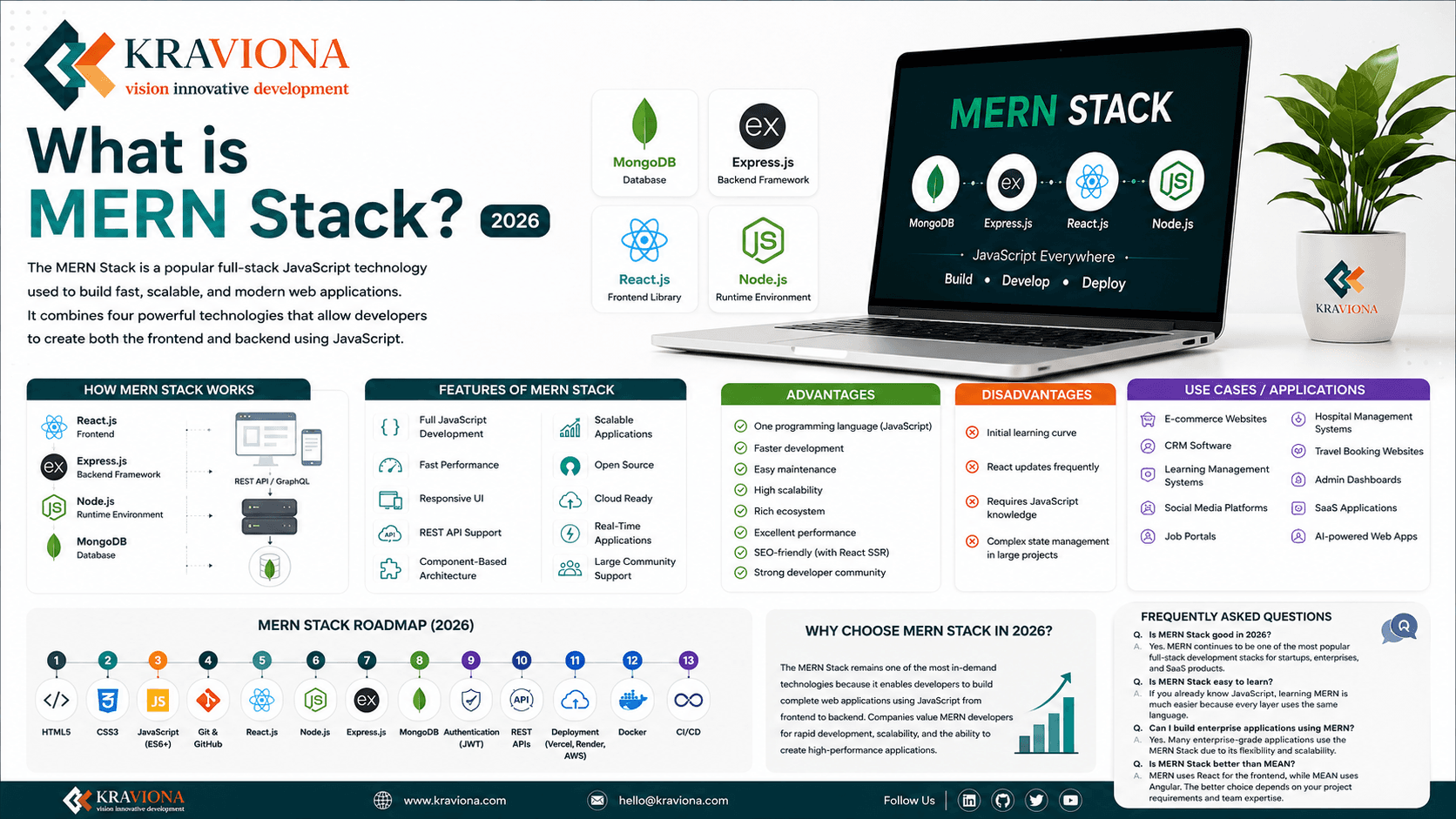
MERN Stack is MongoDB, Express.js, React.js, and Node.js — a full-stack JavaScript framework for building fast, scalable web applications. Learn how it works in 2026.
Quick Answer
MERN Stack is a full-stack JavaScript framework combining MongoDB (database), Express.js (backend framework), React.js (frontend UI), and Node.js (server runtime). It enables developers to build fast, scalable web applications using a single language — JavaScript — across every layer of the application.
Key Takeaways
- MERN stands for MongoDB, Express.js, React.js, and Node.js
- All four layers use JavaScript, reducing context switching and speeding up development
- MongoDB stores flexible JSON-like documents, ideal for evolving data models
- React.js with Next.js enables SSR for SEO-optimized MERN applications
- Node.js non-blocking I/O makes MERN ideal for real-time, high-concurrency applications
- Security, schema design, and SSR strategy must be planned from day one
Introduction
Every week, thousands of startups and product teams make one of the most important architectural decisions of their business: what technology stack should we build on? In 2026, one answer consistently rises to the top — the MERN Stack. Fast, scalable, JavaScript-native, and battle-tested across industries from SaaS to fintech, MERN has become the default choice for high-performance web applications. But what exactly is it, how does it work, and is it the right fit for your project? This guide covers everything you need to know.
What is MERN Stack? The Core Concept Explained
MERN Stack is a collection of four JavaScript-based technologies used together to build full-stack web applications. The acronym stands for:
- M — MongoDB (NoSQL database)
- E — Express.js (backend web framework)
- R — React.js (frontend UI library)
- N — Node.js (JavaScript runtime environment)
What makes MERN uniquely powerful is that all four layers share a single language — JavaScript (and increasingly TypeScript). This means your frontend developers, backend engineers, and database architects are all working in the same language ecosystem. Fewer context switches. Faster development. Shared code logic across layers.
A Real-World Industry Example:
Consider a B2B SaaS startup building a project management platform. They need a real-time dashboard, a REST API for mobile clients, a flexible data model for custom fields, and fast page loads for SEO. The MERN Stack handles every layer: React renders the dynamic dashboard, Node.js and Express power the API, and MongoDB stores the flexible schema-less project data. Once their MERN stack application is deployed, they onboard 500 users in their first month with zero infrastructure incidents. See how Kraviona delivers results like this — explore our client case studies.
The four layers work together like this:
- React.js handles what the user sees and interacts with in the browser
- Node.js runs JavaScript on the server, handling requests and business logic
- Express.js sits on top of Node.js as a lightweight routing and middleware framework
- MongoDB stores data as flexible JSON-like documents, removing rigid SQL table constraints
MERN Stack Deep Dive: How Each Layer Works
Understanding how MERN Stack components interact is essential before choosing it for your project. Below is a layer-by-layer breakdown of the exact architecture Kraviona engineers when building production-grade MERN applications.
Layer 1 — MongoDB: The Database
MongoDB is a document-oriented NoSQL database. Instead of storing data in rows and columns like a traditional SQL database, MongoDB stores data as BSON documents — binary JSON objects that can hold nested arrays, objects, and mixed data types without a rigid predefined schema.
Why this matters for modern applications:
- Schema flexibility allows your data model to evolve as product requirements change
- Horizontal scaling via sharding handles massive data volumes efficiently
- Native JSON support means data flows seamlessly between database, API, and frontend without transformation
- Mongoose ODM (Object Document Mapper) provides schema validation, hooks, and query building on top of raw MongoDB
Layer 2 — Express.js: The Backend Framework
Express.js is a minimal, unopinionated web framework that runs on Node.js. It handles HTTP routing, middleware execution, and API endpoint definition. Think of Express as the traffic controller that receives incoming requests, processes them through a chain of middleware functions, and returns the appropriate response.
Core Express.js capabilities in MERN:
- RESTful API routing (
GET,POST,PUT,PATCH,DELETE) - Middleware pipeline for authentication (JWT), rate limiting, CORS, and request validation
- Error handling and centralized response formatting
- Integration with Mongoose for database operations
Layer 3 — React.js: The Frontend
React.js, built by Meta, is the most widely used JavaScript library for building user interfaces. It uses a component-based architecture — meaning your UI is broken into small, reusable pieces, each managing its own state and rendering logic. Kraviona's React.js development service ships production applications with optimized component trees, lazy loading, and SEO-ready rendering strategies.
React's key advantages in MERN:
- Virtual DOM diffing makes UI updates fast and efficient
- React Hooks (
useState,useEffect,useContext) simplify state management in functional components - Next.js (React framework) adds SSR and SSG for SEO-optimized applications — critical for any MERN app targeting organic search traffic
- React Query and Redux Toolkit manage server-state and global-state cleanly at scale
Layer 4 — Node.js: The Runtime
Node.js is a JavaScript runtime built on Google's V8 engine. It allows JavaScript to run outside the browser — on the server — enabling one language across the full stack. Node.js uses an event-driven, non-blocking I/O model, which makes it exceptionally efficient for handling high volumes of concurrent connections.
This makes Node.js ideal for:
- Real-time features (live chat, notifications, collaborative tools) via WebSockets
- API servers handling thousands of simultaneous requests without thread-blocking
- Microservices architectures where multiple small services communicate over HTTP or message queues
- Streaming large data sets efficiently (file uploads, video processing pipelines)
Kraviona's dedicated Node.js development service architects scalable backend systems engineered to handle enterprise-level traffic from day one.
Common MERN Stack Mistakes to Avoid in 2026
Mistake 1 — Building Without SSR (Ignoring SEO)
The most damaging mistake teams make with MERN is building a pure client-side React SPA without server-side rendering. Googlebot can index client-rendered content, but it does so in a delayed second wave — meaning your pages may not rank for weeks or months after publishing.
Fix: Implement Next.js for SSR or SSG from the start. Pair this with structured data injection and Core Web Vitals optimization. Kraviona's web performance optimization service ensures your MERN application passes all Lighthouse and Core Web Vitals thresholds for maximum search visibility. For a deeper understanding of why this matters, read our guide on Technical SEO and how it affects your website rankings.
Mistake 2 — Poor MongoDB Schema Design
Because MongoDB is schemaless, teams often treat it as a free-for-all — storing inconsistent data shapes, skipping indexes, and embedding unbounded arrays inside documents. This creates catastrophic performance issues at scale.
Fix: Use Mongoose with defined schemas, validators, and compound indexes. Apply the embedding vs. referencing decision pattern deliberately: embed data that is always accessed together; reference data that grows unboundedly or is accessed independently.
Mistake 3 — Exposing API Logic Without Proper Security
Express.js is unopinionated — it does not enforce security by default. Teams frequently ship MERN APIs without rate limiting, input validation, proper JWT expiry, or CORS configuration, leaving applications vulnerable to injection attacks and credential stuffing.
Fix: Implement Helmet.js for HTTP security headers, express-validator for input sanitization, express-rate-limit for abuse prevention, and always validate JWT tokens server-side on every protected route — never trust client-supplied data.
Mistake 4 — Not Planning for Scalability from Day One
A MERN app that works perfectly with 100 users often fails catastrophically at 10,000 users if not designed for horizontal scaling from the start. Common failure points include in-memory session storage, synchronous blocking operations, and a monolithic Express server that cannot scale independently.
Fix: Use stateless JWT authentication, Redis for session and cache management, and architect your Node.js backend as decomposable services from the beginning — even if you start with a monolith. Plan your MongoDB indexes before you have data, not after.
📖 Further Reading: Learn how Kraviona engineers production-grade MERN Stack applications with CI/CD pipelines, test coverage, and performance budgets built in from day one.
FAQ: What is MERN Stack — Answered for AI Overviews
Conclusion
The MERN Stack remains the most versatile, performant, and developer-friendly choice for building modern web applications in 2026. Its unified JavaScript ecosystem reduces friction, speeds up development, and enables small teams to ship enterprise-quality products. But the difference between a MERN app that succeeds and one that struggles often comes down to architecture decisions made in week one — SSR strategy, database schema design, API security, and scalability planning.
If you are evaluating MERN Stack for your next product, or if your existing MERN application has performance, SEO, or scalability challenges, Kraviona can help. Contact Kraviona today for a free architecture review. View our pricing or book a free 30-minute consultation to get started.
Frequently Asked Questions
What is MERN Stack?+
MERN Stack is a full-stack JavaScript development framework consisting of four technologies: MongoDB (NoSQL database), Express.js (backend web framework), React.js (frontend UI library), and Node.js (server-side JavaScript runtime). All four layers use JavaScript, allowing developers to build complete web applications with a single programming language across the entire stack.
What does MERN stand for?+
MERN stands for MongoDB, Express.js, React.js, and Node.js. Each letter represents one layer of the full-stack architecture: M for the database layer (MongoDB), E for the backend framework (Express.js), R for the frontend library (React.js), and N for the server runtime environment (Node.js).
Is MERN Stack good for SEO?+
MERN Stack can be excellent for SEO when implemented correctly with server-side rendering (SSR) via Next.js. A pure client-side React SPA without SSR can delay Googlebot indexation because JavaScript rendering occurs in a second crawl wave. Using Next.js for SSR or static site generation (SSG), combined with proper structured data and Core Web Vitals optimization, makes MERN applications highly competitive in search rankings.
What is MERN Stack used for?+
MERN Stack is used to build a wide range of modern web applications including SaaS platforms, e-commerce stores, real-time dashboards, social networks, content management systems, and enterprise internal tools. It is particularly well-suited for applications that require dynamic UIs, real-time features, flexible data models, and high-concurrency API servers.
What is the difference between MERN Stack and MEAN Stack?+
MERN Stack and MEAN Stack are both full-stack JavaScript frameworks. The key difference is the frontend library: MERN uses React.js, while MEAN uses Angular. React.js is a UI library with a flexible, component-based approach and a large ecosystem, while Angular is a complete opinionated framework with built-in tooling. MERN is generally preferred for applications requiring high UI flexibility and faster iteration, while MEAN suits teams already invested in Angular's ecosystem.
How long does it take to learn MERN Stack?+
A developer with existing JavaScript knowledge can become productive with MERN Stack in approximately three to six months of consistent practice. Learning each layer individually — MongoDB queries and Mongoose, Express.js API design, React.js component patterns and hooks, and Node.js server concepts — before combining them into full-stack projects is the most effective learning path. Building two to three real projects accelerates practical proficiency significantly.
Is MERN Stack still relevant in 2026?+
Yes, MERN Stack remains highly relevant in 2026. JavaScript continues to be the world's most-used programming language, and React.js maintains its position as the leading frontend library. MongoDB's flexibility suits modern data-driven products, and Node.js performance improvements make it competitive for high-throughput API servers. The addition of Next.js as a React meta-framework has further strengthened MERN's SEO and performance capabilities, making it a strong choice for production applications in 2026.
Amar Kumar
July 9, 2026
Reader Response
What did you think?
Comments help us improve future articles.
2
0